Today’s post is the 300th on be the future! I published my first essay here way back in 2019, a time when everyone thought things were the worst they could ever get. My husband Jamie has supported this outlet and my work from the very beginning. They helped me celebrate be the future's 300th post the same we celebrated the 200th and 100th post before it: by co-writing a film essay!
For our first essay, we wrote about the provocative film Born in Flames. In our second essay, we analyzed the phenomenal Jeanne Dielman, 23 quai du Commerce, 1080 Bruxelles. Today we bring you a collaborative post about one of my all-time favorite films: Salt of the Earth (1954).
this is a collaborative post: concepts and words by Jamie Martinez and josh martinez.
It's known as the only blacklisted film in American history. It was one of the very first independent films made without major studio support. Its director, producer, and screenwriter were all blacklisted for their ties to communism. It's a film from a time when support for labor unions was high, in a year where more than 5 million people went on strike. It's based on the true story of a strike that lasted 2 years, starring many of the people who lived it. It’s a feminist and communist film with a largely Mexican American cast. Salt of the Earth is a story of one town's struggle against the company that owned everything around them.
Salt of the Earth is a dramatic retelling of the Empire Zinc Company strike of 1950. The film centers Esperanza Quintero, the protagonist played by Mexican actress Rosaura Revueltas. Esperanza and her family live in a New Mexico town that locals used to call San Marcos but is now named Zinc Town. Esperanza is pregnant with her third child. Ramón, her husband, has worked in the town's zinc mine for 18 years. Esperanza narrates, "The land the mine is on used to belong to my husband’s grandfather. Now it belongs to the company." That company, Delaware Zinc, Inc., owns this mine and others in the area. The company also owns the miners' homes: as Esperanza says, "the house is not ours, but the flowers are." Delaware Zinc runs all the stores in town, including the one that leases an expensive radio to Ramón. But the Quintero home, unlike the ones where the Anglo miners live, lacks a bathroom and running water. The opening credits roll as Esperanza chops wood and heats water—her back bending from the work—to do laundry in the yard.
On Esperanza's name day, Ramón faces a close call at the mine and is nearly injured. Cost-cutting at this mine, worked but not led by Mexican American miners, is not as safe as Anglo-worked mines in the area. The mining union begins to organize a protest against these unsafe conditions. Though the wives urge them to add sanitation to their list of demands, the men deem it unimportant. Soon, another injury at the mine leads the men of the union to call a strike. Over the next 2 years, the company makes several attempts to break the strike. They invoke the Taft-Hartley Act to prevent the union from picketing or face arrest. This Act made it illegal for unions to strike unless they could prove they had no communist members.
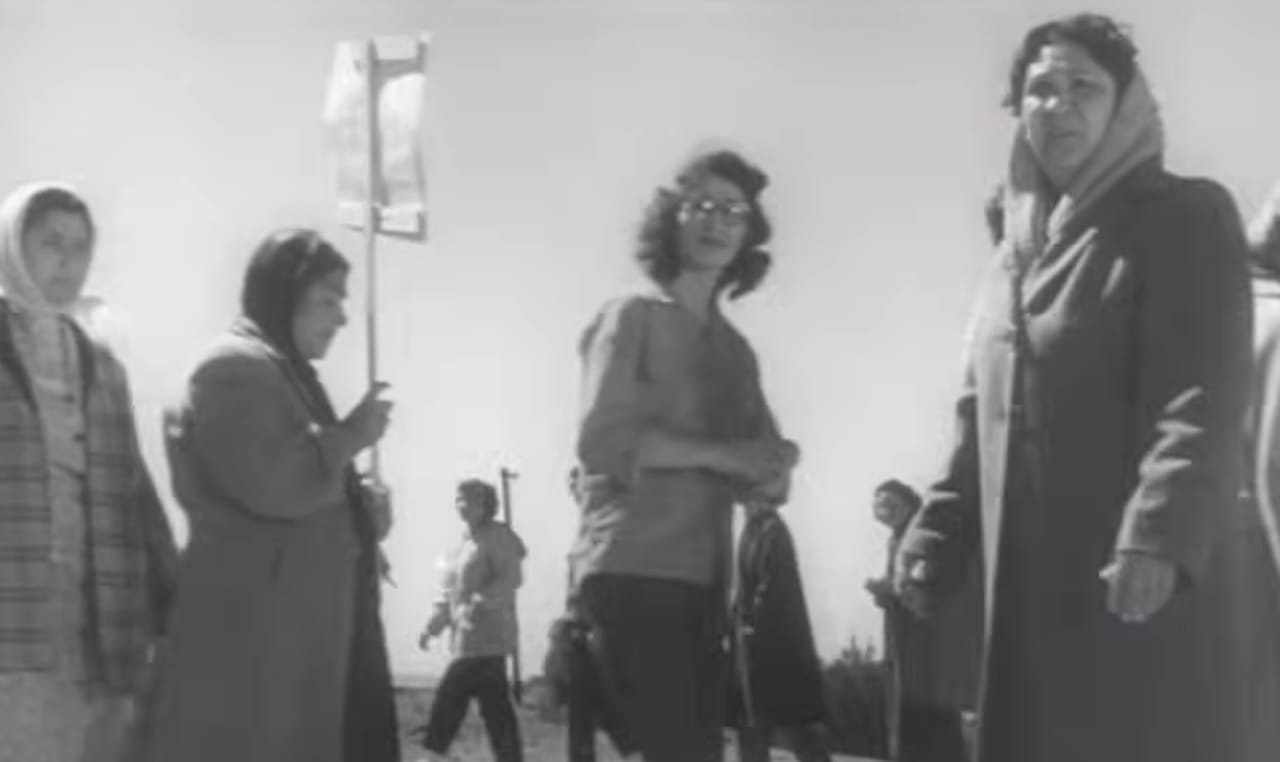
The women of the town argue that they are not union members: they can hold the picket line without breaking the law. They take up the protest signs the very next day. Day after day, the women endure harassment, tear gas, and retaliation. Nothing breaks the line until the sheriff arrests the entire group. The women take their protest to the jail, singing together in protest about the conditions they’re in. By the end, the company moves to evict the Quinteros from their home. This is the final straw. As hired men begin to remove their belongings, everyone in town begins to surround the home. People step in to carry their belongings back inside faster than the goons can carry them out. Having thrown everything they can think of at this community, the mine company backs off. The workers and their families had finally won.
Only Rosaura Revueltas and a few white actors had prior acting experience. The original plan for the film itself was to cast a full ensemble of actors. But many of the actors fled the production, fearing the end of their careers if they worked on a blacklisted film. Mine workers from the Empire strike took many of the roles, including Juan Chacón, a union leader, who played Ramón. The united states even deported Revueltas during filming. Director Herbert Biberman shot her remaining scenes near her home in Mexico City. In an ironic twist, Hollywood unions forbade their members from working on the film. They too feared the film's ties to communism and the backlash they might face. Even after its release, few theaters in the united states were willing to risk screening it.
The film is more than a morality play made by blacklisted Communists and union workers. It's a story of resistance against struggles that feel impossible. It challenges the popular beliefs of the era around race, feminism, and colonization. Here are some of the themes that resonate with us even today.
the struggle to share power
Mexican Americans often received worse pay and living conditions compared to Anglo workers. This too was the case at the Empire Zinc Company: Mexican Americans at that time could only work jobs in the mine itself. Most of the Anglo workers, in contrast, had opportunities to work in the office on the surface. The Mexican Americans had to build their own homes while the company built homes for Anglo families. These homes, built on company land, meant that each family paid rent for a house they built themselves. The homes also lacked indoor plumbing, unlike the homes where the Anglos lived.
The film and the real-life events are both set around 40 years after New Mexico became a state. Given the ancestry of most of its residents, the u.s. federal government resisted granting statehood. They viewed New Mexico’s Indigenous Mexican culture as too dissimilar to the country as a whole. New Mexico passed Jim Crow-style laws to target communities that had lived there before u.s. colonization. Similar laws also targeted Black and Asian residents of the new state. These laws were part of a century of pressure to segregate New Mexico led by former Texans who had moved there.
The version of Zinc Town in the film is not too dissimilar from company towns still found around the world. In the film, Ramón's grandfather once owned the land on which Zinc Town now stood. It's unclear what, if any, benefit Ramón's family received from this land transfer. Two generations later, the Quinteros struggle to make ends meet on that same land. The state and business interests work hand in hand to suppress the people who still live there.
This tradition of company towns still exists in the present day. Bay Lake and Lake Buena Vista, owned by Disney, are a type of company town made for high-level employees. SpaceX incorporated its own town, Starbase, in South Texas earlier this decade. A SpaceX vice president became its first mayor. Like in the mining days, companies are free to bypass some environmental and labor laws in towns they own.
Colonization does not occur without a concept of race. The american empire began with the theft of land and of bodies stolen for enslavement. Motivating these acts is the false belief that the Anglo body is superior, or worth more, than the bodies of other people. Salt of the Earth asks us to consider why only some people can have their needs met without struggle. An Anglo miner can move up and out of this mine in ways that Mexican American miners cannot. There was no ladder of success for them, only the knowledge that there were two separate ladders.
In the film, a group of men try to break the strike by running past the picket line. The company has offered them temporary jobs at the mine; to take one of these jobs is to become a “scab.” These strike breakers are another way the company holds onto their power with none of the risk. As soon as Ramón and a few men run to intercept the scabs, the sheriff can move in to arrest them. We learn that one of the strike breakers is a man named Sebastian. The fact that Sebastian is also Mexican American shocks Ramón enough to spit on him. Sebastian cries that he has a family to feed, just like Ramón does. Why is one family's needs worth more than another? The company put these men in conflict with each other on purpose. It disrupts the conflict both men, together, should have with the company. The scene between these men offers a valuable reminder. We fight each other when we could be working together against the ones who oppress us both.
the struggle for solidarity
The remedy to injustice, the film teaches us, is solidarity. The miners' solidarity as union members is a potent form of power. In a pivotal moment of the film, Delaware Zinc and state agents join forces to break the strike once and for all. Instead, the union and the townsfolk stand united. Union members from other towns and industries also show up to help push back against this power.
And when pushed, the representatives of the mine can't honor the union's demands on their own. They have to contact the New York office, back east, before they can concede the fight. It's interesting that they had free reign to do whatever it took to break the workers. They were free to jail people, to jeopardize their family's lives, even make them all homeless. But these leaders felt powerless to end the rampant racial discrimination at the mine they oversaw. They could not meet the strikers' demands without getting out-of-state approval first.
We learn this lesson another way through the interactions between men and women. When the film begins, it's clear that the other union members, even the bosses, see Ramón as a leader within the group. The company tries to break the strike with threats of arrest or lost income for the union members. Esperanza and the other wives step in to protest on their behalf. The wives want an equal say in the conditions under which they live. Their concerns about sanitation affect the wellbeing of the whole family. We would argue that those concerns are as important as the safety conditions within the mine. But here again, the company pits the two leaders of each household against each other.
The wives join the strike through a clever loophole, something we the viewer can admire. But this inversion of gender roles does not sit well with Ramón and his comrades. With women on the picket line, it falls to the men to perform the domestic labor needed at home. Ramón refuses to accept the strength of the movement because women are the ones leading it. There's no doubt he loves his wife, but society conditions him to be the sole provider of the household. We witness his influence diminish during the course of the movie.
Towards the end of the film, Ramón’s frustration with the situation gets the best of him. In a particularly powerful scene, he approaches Esperanza with anger. His jealousy with her power and his role within the home getting the best of him, he demands that she steps down. What comes next from Esperanza is likely the best known monologue from the film:
The Anglo bosses look down on you and you hate them for it. “Stay in your place, you dirty Mexican.” That’s what they tell you. But why must you say to me: “Stay in your place”? Do you feel better having someone lower than you?
Whose neck shall I stand on to make me feel superior? And what will I get out of it? I don’t want anything lower than what I am. I am low enough already. I want to rise and to push everything upwards as I go! And if you can’t understand this, you are a fool, because you can’t win this strike without me.
Esperanza comes to understand the true fight they have before them. They work in unsafe conditions to live in a rented house without plumbing on land that should be theirs. Only solidarity and equality, even and especially within the home, can change any of that. Ramón ignored the struggles that Esperanza faced in her own domestic responsibilities. Instead of supporting her, seeing their causes as united, he saw her as an obstacle. Her own demand for agency is what prevents him from returning to a status quo that did not serve either of them. She wants him to be a peer to her; he doesn't realize that's also what he needs from her. In his frustration, as he prepares to strike her, she says with defiance: “That would be the old way. Never try it on me again.”
propaganda or resistance?
The director of Salt of the Earth is Herbert Biberman, a member of the communist party as of the mid-1940s. He refused to testify to the House Un-American Activities Committee about his membership in the american communist party. He received a 6-month jail sentence and a blacklisting from Hollywood. To make Salt of the Earth, Biberman formed a team of other blacklisted professionals. The International Union of Mine, Mill and Smelter workers gave support to make the film. This union had refused to purge suspected communists from their member rolls. As a result, their parent union, the Congress of the International Order (CIO), cut them off.
The film is a strong example of agitprop. This is a term used in the Soviet Union to describe propaganda that promotes communism. While the film doesn't have an explicit pro-Soviet message, its point is clear: all people must work together if they are to have their needs met. This idea was (and still is) dangerous in the post-war and cold-war eras of u.s. politics. This made the film near-impossible to screen in this country for several decades.
Salt of the Earth is plain with its politics. It's worth considering more recent films that have a somewhat left-leaning bent. In 2026, the Hollywood studio system is once again consolidating itself. The original "Big 5" studios became 7, then 6 in the 1980s. Another merger in 2019 led to another era of 5 major studios in Hollywood. The Skydance merger that took place this year brings that number even lower—to just 4 major studios. An industry run by four billion-dollar companies might not fund, much less promote, a radical story of worker’s rights and labor organizing.
To be fair, we do still see late-stage-capitalist films about class divides or racism. But very few of those movies address the history and dangers of worker uprisings within the u.s. Filmmakers might get away with stories that focus on uprisings and strikes in the 1960s to 1980s. In recent years, the last two films made by director Boots Riley are subversive critiques of race, capitalism, and worker exploitation. But the worlds in these films are full of fantastical imagery and zany environments. The message in these films may be lost when compared to the realities and limitations we face in the real world.
the struggle continues
Though there's much to find relevant here, the struggle on screen still feels small at times. On-screen and off, the Mexican American workers found very few white allies to join their fight. It's clear that this failure of imagination among the Anglo workers is due in no small part to race. Perhaps many of them thought, "why should I put my own job on the line?" It's possible that, like Sebastian, their first priority was to put food on their own family's table. Why risk more?
In hindsight, many of the conditions those miners faced are still with us today. Their descendants now toil in gig worker jobs or dangerous warehouse work. We give our bodies and livelihoods to billionaires, whether by employment or endowment. We saddle ourselves with debt trying to make ends meet. What if, instead, every miner decided their working conditions didn’t have to be dangerous at all? What if they could achieve a higher standard for all workers, if only they all stood together?
Today, very few of us toil in the mines that these brave Mexican Americans endured. But our struggles are bound together with them, if only we're all brave enough to notice.
Salt of the Earth is available to watch for free on Kanopy and youtube. It's worth your time to explore this film's messages and their relevance today.
 Log in





 Spoilers ahead for the plot of