Log in


Spoiler Alert: While I won’t be giving away the entirety of You Can See Everything, I will have to discuss some important aspects of the film in order for this to be a piece worth reading. So if you hate a spoiler, you may want to watch the film before reading this.
My spouse and I have been thinking about You Can See Everything since we saw it in theaters a few days ago. It is a very well made, interesting film. My ADHD makes it almost impossible for me to sit through an entire movie, but y’all, I did not move for the entire three hours of this. I have never seen a documentary like it, and at the same time, I feel like it highlights a fundamental truth about all documentaries: we are always being manipulated.
The manipulation is a main character in this film, not only from Elizabeth Holmes and her horrible partner Billy Evans, but from Nathan Fielder (which is a surprise to nobody who has seen his work before), and pretty much everyone else involved in this project. Who is telling the truth? Who is lying? Who is being taken advantage of? The only thing that we can be really sure of after watching the film is that we, the viewer, are being taken for a ride - one that we’ve willingly paid for.
I don’t normally want to watch a film about the trials and tribulations of a wealthy white woman, it is one of my least favorite genres (30-something white man trying to find himself and heal his relationship with his dad via road trip and sex with quirky white women is perhaps my all-time least favorite). But I am a fan of Nathan Fielder, and I must admit to following the Elizabeth Holmes case as it was unfolding, and it just looked so interesting.
And it was interesting, and surprising, and a very good piece of film. And I left with conflicted feelings (which I absolutely believe was the filmmakers’ intent) that I’m still sitting with. And as I’ve thought about this film over the past few days, what has really stood out to me is the overwhelming whiteness of the particular symbiotic abuse of Elizabeth Holmes, Billy Evans, and all of us.
Let me start off by saying this: I wish nothing but awful things for Billy Evans. It has been a long time since I’ve disliked a man so instantly and deeply. He is a manipulative, controlling, narcissistic, misogynist. I want to telepathically send bedbugs to every hotel he ever stays at. I want him to shit himself every time he has a sip of an energy drink.
Watching the film, it becomes clear that Evans set his sights on Holmes because she was mired in controversy, not in spite of it. It is clear that he sees her infamy as his path to fame, wealth and power. It is clear that he has no respect for women - his own partner included. I can bet you money that on some level Evans is thankful for every day that Holmes is in prison, because it’s another day that he gets to literally play her like an online avatar.
And I do not think Holmes should be in prison - not because I do not think she is guilty of the crimes she was accused of - but because I do not think anybody should be in prison. I am sad for her and her children, just as I am sad for all incarcerated people and their loved ones.
But as we watch Fielder’s desperate attempts to let Holmes know how Evans is manipulating her and her image, it becomes very clear that Holmes doesn’t want to know. And her not wanting to know is not born out of a desire to preserve her own image of her partner as some perfect man, but to preserve her own image of herself as the perfect innocent.
Holmes is a smart woman. Yes, it is clear that she is likely neurodivergent in some way. But she also (and I say this as a neurodivergent woman) wears that neurodivergence as a costume. She both “doesn’t get it” but also knows exactly how to communicate to you how she doesn’t get it. She is clueless but in a way that is so scripted as to leave you with no doubt of how clueless she is. She is vulnerable and lost but in a way that never leaves her for a loss of ways to tell you about how vulnerable and lost she is.
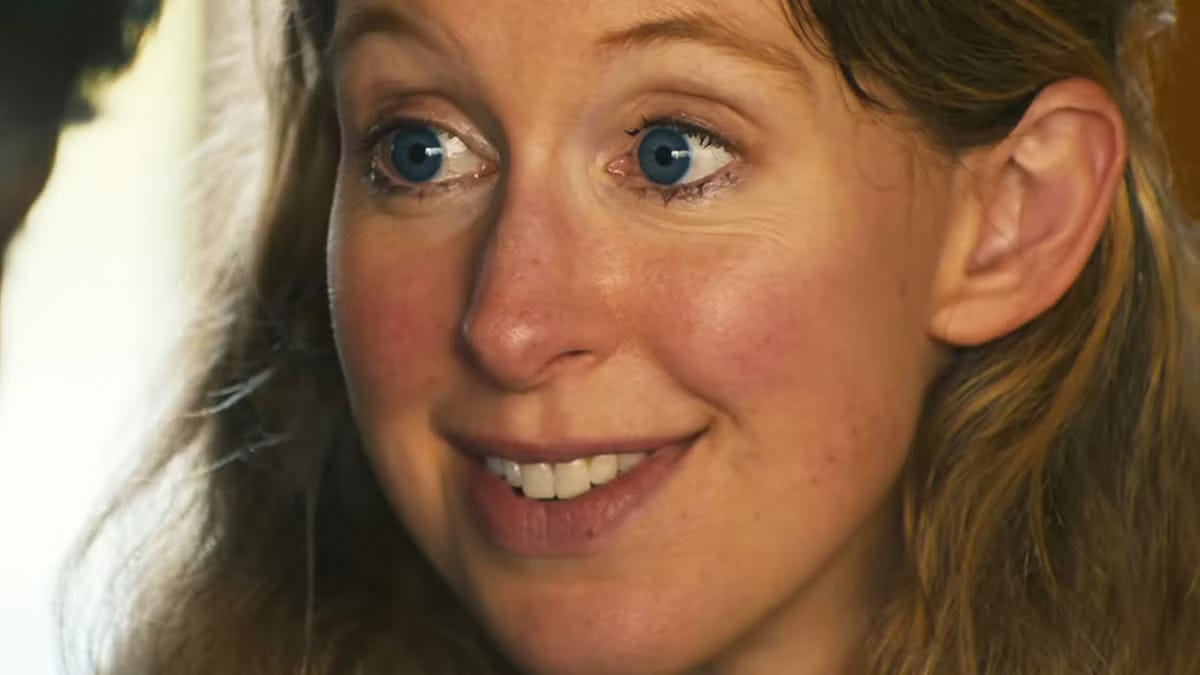
And she’s a woman who was so polished and poised and controlled when she was a “self-made” billionaire, and is now in this film a messy-haired, wide-eyed, sad and confused woman in a rental home by the water. Even the home that this documentary is filmed in feels like part of Holmes’ costume. Just months before filming, she and her small family were living in a multi-million dollar estate in the Bay, but for this time before her incarceration, when they were not only filming this documentary, but also trying to convince judges that they were experiencing extreme financial hardship, she was in a modest, outdated, two bedroom cottage.
When Fielder tries to talk to Holmes about the manipulations of Evans, it is clear that she had no desire to hear it. And she is so confident in that desire. She knows that not knowing is best for her. Just as it was best for her to not know the details of her ex partner’s actions.
I say this without reservation: Holmes is being controlled and manipulated by Evans. But I also say this, with perhaps a little reservation (mostly because it just feels shitty to say): Holmes wants to be controlled and manipulated by Evans, because it allows her to control and manipulate us.
Holmes wants money, power, influence. Holmes wants to cut backroom deals for profits off of the documentary about her and she wants people who portray her in a less-than-favorable light to be punished, and she wants to be the next phenom - and she doesn’t want to be seen wanting it. She doesn’t want to be held responsible for it. She wants it to be done for her and she wants to hide behind the people who are doing it.
And it feels so fucking familiar.
I’ve encountered so many white women like this. White women whose husbands “take care of them” while also harming others. White women who have Black friends and queer friends and their partners get drunk and say slurs and likely voted for Trump but they can never say one way or the other because they “don’t discuss politics”. White women who complain that their order is wrong and then disappear to the bathroom so their partners can yell at the server without them having to witness the awkwardness of it all, and then return to eat their now correct dish.
There is a dual-narcissism to these kinds of relationships. The overt narcissism of the man who needs to look like the most important, smartest, most in-control person in the room, and the quiet narcissism of a woman who needs to be the most innocent, the most faithful, the most oblivious person in the room. And there is a chicken-or-egg question here, to be sure. Was Holmes like this before these men came into her life? Did she seek them out to help them accomplish her goals? Or did these men condition her to be this way? I’ve seen both, and I’ve also seen that it’s often a combination of both.
I think that Holmes absolutely knows who her partner is, and what that allows her to do. And I do think that should she need to in a few years time, if Theranos 2.0 doesn’t work out or if she just needs a way to get back into the spotlight, she will absolutely point to this film and use her emancipation from the villain that is Billy Evans to launch her new brand.
But in the meantime, this man - this narcissistic misogynist- is raising her kids. And that’s what I really can’t stop thinking about. He’s raising her kids with 100% unchallenged control; not only because she is in prison, but because she has given him power of attorney over her life and has seemingly rejected any opportunities for knowledge or empowerment as to what decisions her partner is making. She knows at least to a good degree what type of man her partner is and she has given up any control over how her children are raised by him and one day, when her kids ask her why, she will say - with wide, innocent eyes - that she didn’t know, that perhaps she should have asked more questions, but she was just so trusting, so in love.
And she is trapped now, in so many ways. She is in prison. This man does have her kids. He has control over her life in a way that I wouldn’t wish on anyone. And as frustrated as I am over the way Holmes clings to plausible deniability as to who her partner really is, who her ex partner really was, and how much agency she has had in the harmful things she’s done, I can see why right now why she clings to it. She needs to see her kids. She needs someone to keep her name in the limelight. And when she gets out of prison, she needs someone to be the reason why you don’t know the real her, why it isn’t her fault, why she deserves a second chance.







 Spoilers ahead for the plot of