prodigious reader, chronic forgetter
4500 stories
·
13 followers

so you might join a board...

1 Share
so you might join a board...

More than a year ago, I approached my friend Itai with an idea. I had sought their advice a few months earlier about a board I was planning to join. Our initial conversation had gone so well that I asked them to write an essay with me. We decided to write a guide for folks like us who were considering board service but didn’t know who or what to ask. The more we talked, the more we realized we had so much information to share that it wouldn't fit in a single post. At our very first meeting we outlined who this book was for:

Folks who identify as Black, Indigenous, People of Color, or People of the Global Majority

  • LGBTQIA+ folks
  • Poor folks

We gathered the sum of our experiences from serving on and working with boards of directors. We spent months in collaboration to write and revise our advice. We hired an incredible illustrator (Trae Middlebrooks) and asked colleagues with board experience to review our manuscript.

And then we published our book! Buy So you might join a board... on gumroad.

We want everyone, especially folks in our priority audience, to read this. We hope the book finds a second audience among board members who want to know how their boards can be more welcoming. It can help them think about the answers that any prospective board member might need to know.

We priced this book for large nonprofits and institutions who can afford our advice. But organizations with small budgets can use the discount code BOARD to buy the book for $50. Our primary audience, who we want more than anything to read this book, can use discount code POWER to buy it for $1. We offer these codes on the honor system for folks who can use them. And if our lowest price is a hardship for you (or you don’t have the means to buy online), please email store@bethefuture.space for a free copy, no questions asked.

Check the book out on gumroad. If you'd like to read before you share, I've excerpted our introduction below:

introduction for So you might join a board...

Organizations rely on their board of directors to provide governance and financial oversight. The law requires nonprofits to have a board of directors to ensure they act in the best interests of the community. When done well, a board of directors is a group of folks with a diverse set of skills, backgrounds, and experiences. But like many of society’s spaces, most boards are monocultural by design, built to serve the needs of a fraction of the community. A board can include members who don’t know much about the communities their nonprofit serves. We're grateful to know that many organizations are working to change that. They know that a board of directors should be full of folks who reflect the nonprofit and its community. That might be where you come in…

This guide is for people who identify as Black, Indigenous, or as a Person of Color (BIPOC). You may be thinking about joining a board or someone is recruiting you into one. This guide is also for folks who identify as LGBTQ+ or queer. It's for poor folks or people who don't have an absurd amount of wealth. It's definitely for people who are any combination of the above!

We have both joined and served on boards of directors. They have recruited us for our skills, for our identity, our background, and our values. We've accepted these invitations and we've declined them. We've served on boards and resigned from them. We've found deep joy in guiding the work of an organization that acts in the service of their values. We’ve gained valuable learning experiences and deeper insights into an organization, its industry, and the communities they support.

Why We Need Allies

Today, we're living in an era of american technofascist rule. If we're very lucky, you could be reading this at a time when those threats are over. But for now, many of our community members face unwanted levels of hostile visibility. People who are Black, Latine, and/or trans are fighting for their causes in spite of this attention.

This is a great time for cis and white allies to join the boards of trans- and immigrant-supporting orgs. People with these identities risk arrest, kidnapping, or worse. If you're a trans person considering service on a trans-supporting nonprofit board, please do! They definitely need that. But we can't ignore the risks that trans people and immigrants face. We need people who will be safe stepping forward—taking the heat without taking the reins.

Joining a board of directors is a great way, but not the only way, to support an organization's work. It can be so exciting to give back to a nonprofit that's helped you, your family, friends, or community. The roles board members play will look different depending on the board and organization. Nonprofits are far from being the only form of activism and civic service. But they provide safety nets for communities, the arts,
and critically important causes. These organizations face intense challenges that this moment in our history requires. They need new perspectives and skillsets to help overcome them.

Contributing in a mission-driven way can be deeply rewarding. Folks we know who have served on a board of directors have developed friendships that extended past the conference table. They’ve steered a floundering organization in a new direction or towards greater sustainability. They’ve felt more connected to people in and outside their communities. We want everyone to seek these rewards. We also want people to have a holistic idea of the common requirements, challenges, and risks. Not everyone is aware of the liability that may come with service on a board. Once you're on the board, you're on the hook for the fiscal responsibility and oversight that comes from it. You may also face dynamics that can produce stress and are not a great fit for everyone. We offer this guide in the hopes that it will help you decide if joining a board is right for you.

Buy So you might join a board... on gumroad.

Do you know anyone who might benefit from reading? Please share with them this email/page or the link above! We need all the word of mouth advertising we can get.


Read the whole story
rocketo
3 hours ago
reply
seattle, wa
Share this story
Delete

COLUMN | Bad Bunny Said 'ICE Out' — and Made the Super Bowl Matter to Me

1 Share
Not a football fan, but a Bad Bunny believer: Agueda Pacheco Flores reflects on immigration fear, cultural pride, and why representation still hits hardest on big stages.
Read the whole story
rocketo
3 hours ago
reply
seattle, wa
Share this story
Delete

The Deeper Meaning of Bad Bunny’s Super Bowl Halftime Show

1 Comment
Bad Bunny, dressed all in white with white gloves, stands atop a white pickup truck in front of a field of sugarcane, one hand in the air. All around him are dancers dressed in brown, each with their right hand raised to the sky.

Read the whole story
rocketo
3 hours ago
reply
To conservatives in power, Puerto Ricans are no different from any other brown or Spanish-speaking person: potential criminals one and all, here to take something from good (white) Americans. To their liberal opposition party, they are taken for granted as a demographic that has no choice but to be aligned with them, with families on the mainland expected to vote blue alongside other Latino citizens, without much more than the most feeble outreach.

¡seguimos aquí!
seattle, wa
Share this story
Delete

The Wisdom of Star Trek’s Spot

2 Comments
Column SFF Bestiary

The Wisdom of Star Trek’s Spot

Long before Data has the chip that allows him to feel what humans feel, Spot is his emotional rock…

By

Published on February 9, 2026

Credit: CBS

Data (Brent Spiner) holds his cat Spot in Star Trek: The Next Generation

Credit: CBS

There’s something about a ginger cat.

We’ve seen the greatness that is Alien’s Jonesy. But there is another and possibly even more beloved ginger icon, with a similar arc but more screen time. Spot, Commander Data’s cat on Star Trek: Next Generation, appears in eight episodes of the series, with appearances in two of the films, Generations and Nemesis, plus a cameo in an episode of Picard.

Spot first appears in Season 4’s “Data’s Day.” The episode is a sort of diary, and it has a Theme: friendship. Amid all the alarums and excursions, we learn that Data has a cat. His name is Spot, he’s a long-haired ginger, and Data feeds him and pets him while he works at his computer.

There’s no explanation. We don’t get the backstory on how or why Data ended up with a cat. He’s just there, in the same way Jonesy is just there on the Nostromo.

Spot shows up again near the end of the season, in episode 25 (back in ancient times, TV seasons used to be 26 episodes long), “In Theory.” Again, he’s a long-haired ginger, and he’s a minor mover of one of the subplots. Data has the door of his quarters set to allow only humanoids to pass, but Geordi finds Spot outside and a couple of corridors over.

It’s a mystery, which eventually gets solved. In the process, we learn that Data has been experimenting with numerous cat-food formulas. Spot, it seems, is a picky eater.

The main plot revolves around a sweet young blonde crewperson who makes moves on Data. Data has no emotions at this point, that chip hasn’t been installed, but he’s been developing a program to predict human reactions, and he is amenable to experimenting with a romantic relationship. When the inevitable happens and she breaks up with him, he closes the episode by picking up Spot and cuddling him.

That’s the last we see of Spot until Season 6. In “Schisms”, Spot isn’t present except in verse. Data’s poetry reading (attended by a circle of overwhelmingly bored crewpersons) culminates in the famous, or infamous, “Ode to Spot.” It begins,

Felis catus is your taxonomic nomenclature
An endothermic quadruped, carnivorous by nature
Your visual, olfactory, and auditory senses
Contribute to your hunting skills and natural defenses.

It ends,

And though you are not sentient, Spot, and do not comprehend,
I nonetheless consider you a true and valued friend.

Awful? Brilliant? So bad it’s wonderful? You be the judge.

The cat himself appears in “A Fistful of Datas.” Spot is now an orange shorthair, and we have a pattern of behaviors: he often occupies Data’s lap and/or his computer console (whether Data wants him there or not), and he has, as Data puts it, “highly selective tastes.” It’s an ongoing project to find a formula that Spot will eat. Spot is, in short, a normal cat.

In “The Birthright, Part I,” in which Data first begins to dream, Spot is one of three personal things that appear in the dream: his cat, his potted plant, and his paintings. Spot is just there, part of Data’s mental landscape. But in Season 7, which is the last season of the series, he finally gets a chance to shine.

The first episode of the season, “Descent, Part II,” completes an arc in which Data is equipped with an emotion chip by his evil twin, Lore, but he’s not ready for it. When he comes to that realization, and discusses it with Geordi, Spot is present, doing cat things and allowing Geordi to pet him.

“Phantasms” continues Data’s dream journey, this time with a terrifying twist: Data is having nightmares. The episode begins with Data studying Spot as he sleeps, noting the physical indications that he’s dreaming. Data tells Troi,

“Spot has never seen a mouse or any other form of rodentia. He has never encountered an insect or been chased by a canine.”

Spot is a ship’s cat, though apparently there are no vermin to hunt on a Federation starship. He’s a pet and companion. Data is worried about harming him during one of his waking nightmares, and asks Worf to look after him.

Worf is nonplussed. “Your animal,” he growls, and commands the cat to “Come here.”

Spot is not a canine, Data reminds him. He doesn’t obey verbal commands. When Worf grudgingly picks him up, Data comes near to babbling about his care and feeding. Which supplement he likes, he has to have water, he has to have a sandbox—

“And you must talk to him. Tell him he’s a pretty cat and a good cat…”

“I will feed him,” snarls Worf. That, Data realizes, will have to be enough.

It does seem to be. After Data’s nightmares have been resolved, Spot is back in his quarters again, and Data is teasing him with a fuzzy toy on a wire. As one does.

In “Force of Nature”, Spot has her own major subplot. Geordi has borrowed her in an effort to find out if he wants to get his own cat.

Her. Right. We’ll get to that.

Spot has been manifesting major cattitude. She’s smashed a vase and a teapot, scratched a chair to pieces, and coughed up hairballs all over the carpet. Now she’s hiding under Geordi’s bed and he wants (entirely metaphorically, one hopes) to kill her.

Well, says Data,

“When you borrowed Spot, you said you wanted to experience the full range of feline behavior before getting a cat yourself.”

The answer to that question, Geordi says fervently, is no. He is not ready for a cat. He then tells Data to call her.

Data can’t do that. Spot doesn’t do verbal commands. Well then, Geordi declares, you need to train her.

Data’s attempts to train the cat provide comic relief in an otherwise harrowing episode about, among other things, the ways in which warp drives are endangering the universe. Data concludes after a long and varied series of experiments that she may be inherently untrainable; maybe she lacks the intelligence to process human commands.

While he tells Geordi this, Spot meows at him. He pauses. She meows again. He fetches her favorite string toy and starts to play with her.

“I don’t know about Spot,” says Geordi, “but seems to me your training is coming along just fine.”

Seems to me the cat may be rather smarter than Data recognizes. As for intelligence or lack thereof, it may be worth noting that Data had to prove his own sentience in order to be admitted to Starfleet. The fact that he makes a repeated point of Spot’s lack of it, and yet is so clearly bonded to her (or him), is an interesting and ongoing theme in the series.

The main plot of episode 9 involves an alien scientist who has made a devastating and controversial discovery. No one believes her. She resorts to ever more desperate and aggressive measures, which backfire badly.

Data’s attempts to train the cat are a much gentler reflection of this plotline. They’re teaching a lesson about the difference between persuasion and force.

In Spot’s final episode in the series, “Genesis”, she finally becomes a main character. Spot is pregnant, and Data has been with her every step of the way. He doesn’t know which of the twelve male cats on board is the father—he plans to run the kittens’ DNA after they’re born—but he does know that it happened during one of her escapes from his quarters.

Meanwhile, crisis of the week means that Data may be away from the ship when Spot has her kittens. He entrusts her to Reg Barclay, the only human on board whom Spot seems to like. (Spot is quite expressive about her feelings toward other members of the crew. As in, physical injuries.) Reg seems to adore her, and he knows cats: he understands that she’ll want a dark and secluded place to give birth.

While Data and the captain are away, all hell breaks loose. They come back to find the ship shut down and the crew transformed into prehistoric animals. Spot, when they find her, is an iguana.

But her newborn kittens are still kittens. The placenta, the maternal antibodies, and the amniotic fluid all protected them from the evil space virus. That’s the key to the antidote. With the help of a pregnant crew member, for humanoid amniotic fluid, Data whips up an antidote. Spot has saved the day.

That’s it for Spot in the series. She (or he) appears briefly in Nemesis, but in Generations he (or she) is a catalyst for Data’s major emotional breakthrough. After the total destruction of the Enterprise, as Data and the rest of the crew comb through the wreckage in search of survivors, Troi detects a small life sign in a heap of rubble.

It’s Spot, and Data gathers her up, sobbing into her fur. He’s discovered complex emotions. “I am happy to see Spot, yet I am crying.” He’s spent his life trying to understand what it’s like to be human. Now he knows.

Spot is a constant in Data’s life from Season 4 onward (and possibly throughout, but we don’t meet him until halfway through the series). The appearance changes, the gender changes—on this side of the fourth wall it’s continuity issues and a writer who decided, near the end of the game, that she wanted Spot to be female instead of male—but in the Trek universe, pretty much every being is infinitely mutable. Alien invaders, viruses, strange manifestations of space and time, can change a being’s appearance, gender, even species.

Maybe Spot is a shapeshifter. Maybe there are multiple Spots. Spot 1.0 the long-haired ginger, Spot 2.0 the ginger boy, Spot 3.0 the ginger girl.

They (or he, or she) are Data’s emotional rock. Long before he has the chip that allows him to feel what humans feel, he understands that Spot is his friend. Spot is there, quietly in the background, when he comes to new understandings about human life and human nature. When he’s had a rough day or week or year, he comes back to Spot. From Spot, more than from any other being, he learns how to love.[end-mark]

The post The Wisdom of <i>Star Trek</i>’s Spot appeared first on Reactor.

Read the whole story
jepler
33 minutes ago
reply
Hmm data never took spot to the holodeck? Maybe the safety protocols were optimized for humanoids only.

> “Spot has never seen a mouse or any other form of rodentia. He has never encountered an insect or been chased by a canine.”
Earth, Sol system, Western spiral arm
rocketo
3 hours ago
reply
“I am happy to see Spot, yet I am crying.” He’s spent his life trying to understand what it’s like to be human. Now he knows.
seattle, wa
Share this story
Delete

Purple Lemonade Collective

1 Share
This Local Performance Troupe Radiates Joy and Ass-Shaking Confidence
by Nico Swenson

The world is full of lemons, but thank god there’s Purple Lemonade. This performance collective has taken over the city with their charisma, cross-genre dance, and scantily clad performances. As they strut the stage, you might see elements of hip-hop, reggaeton, flavors of camp—a whole glorious blend of street, club, and contemporary movement that refuses to be boxed into a singular style. From nightlife venues to theater spaces, their acts fill any venue with an ass-shaking confidence that radiates their mission of promoting playful self-expression.

The troupe was cofounded by Ronnie Gatsby and Kristen Puckhaber in 2016. The name pays homage to two of Gatsby’s big artistic influences: Prince and Beyoncé. “Lemonade,” a nod to Beyoncé’s 2016 album, “was Beyoncé taking a shitty experience and making something great,” says Gatsby. “The thing people used to ridicule me for, being flamboyant, is what has made me a place in the world. I turned that shit into lemonade.”

The collective has taken many forms in the past 10 years, but has always centered around a tight-knit, collaborative friendship. “What we value the most is being able to create cool shit together,” says Gatsby. “We love each other. We get to do what we love with friends.” That core value has stayed true as Gatsby passed the role of artistic director to Carlos Vidal.

Vidal joined Purple Lemonade two years ago. “It changed my life,” says Vidal. One of the things he found empowering was the expansive inclusion of styles. “As a performer, you can do whatever you want to do, just be you and show people how talented you are.” That mindset is why the group has expanded into other areas of entertainment, including drag shows, burlesque, and performing at major
venues like the Seattle Art Museum, Seattle Rep, and Pacific Northwest Ballet. Last summer, they performed at halftime with the cast of Tush for Seattle Reign’s Pride Match at Lumen Field. As regulars in local drag shows, they frequently work with local icons like Betty Wetter. “Collaborating with Purple Lemonade is a dream,” says Wetter. “They’ve created an environment full of love and support, so everyone shines when it’s showtime.”

When asked what people can expect to see, Vidal says “ass out.” The collective’s magnetism sends audiences into a frenzy. For Vidal, the inspiration it ignites in
others is a highlight of the work. “Whether that’s a feeling of ‘I’m going to be braver, I can be more expressive, I’m going to show more ass.’ You can make people feel confident, that’s the best part.”

The group creates in a very joint-effort way, with both the founders still part of the family and process. That connective energy will help them tackle a full and exciting year ahead. J’Adore at the Triple Door in February, Live Nude Mammals at Queer/Bar in March, and Hotel Gatsby at Intiman Theater in April are among upcoming events. “We want to be queer everywhere,” says Vidal. “With everything happening right now, we want to bring joy to people and have fun.” 

Read the whole story
rocketo
12 hours ago
reply
seattle, wa
Share this story
Delete

Three Favorite Plant Proteins

1 Share

In this newsletter, I wanted to focus on a topic that I know is of interest to many of you, and a hot topic in these parts: plant proteins. My three go-to’s are highlighted below, with some cooking tips, factoids, and of course my favorite recipes that feature them. I hope you find this helpful and inspiring! —Lukas

Subscribe now

1. Tempeh!

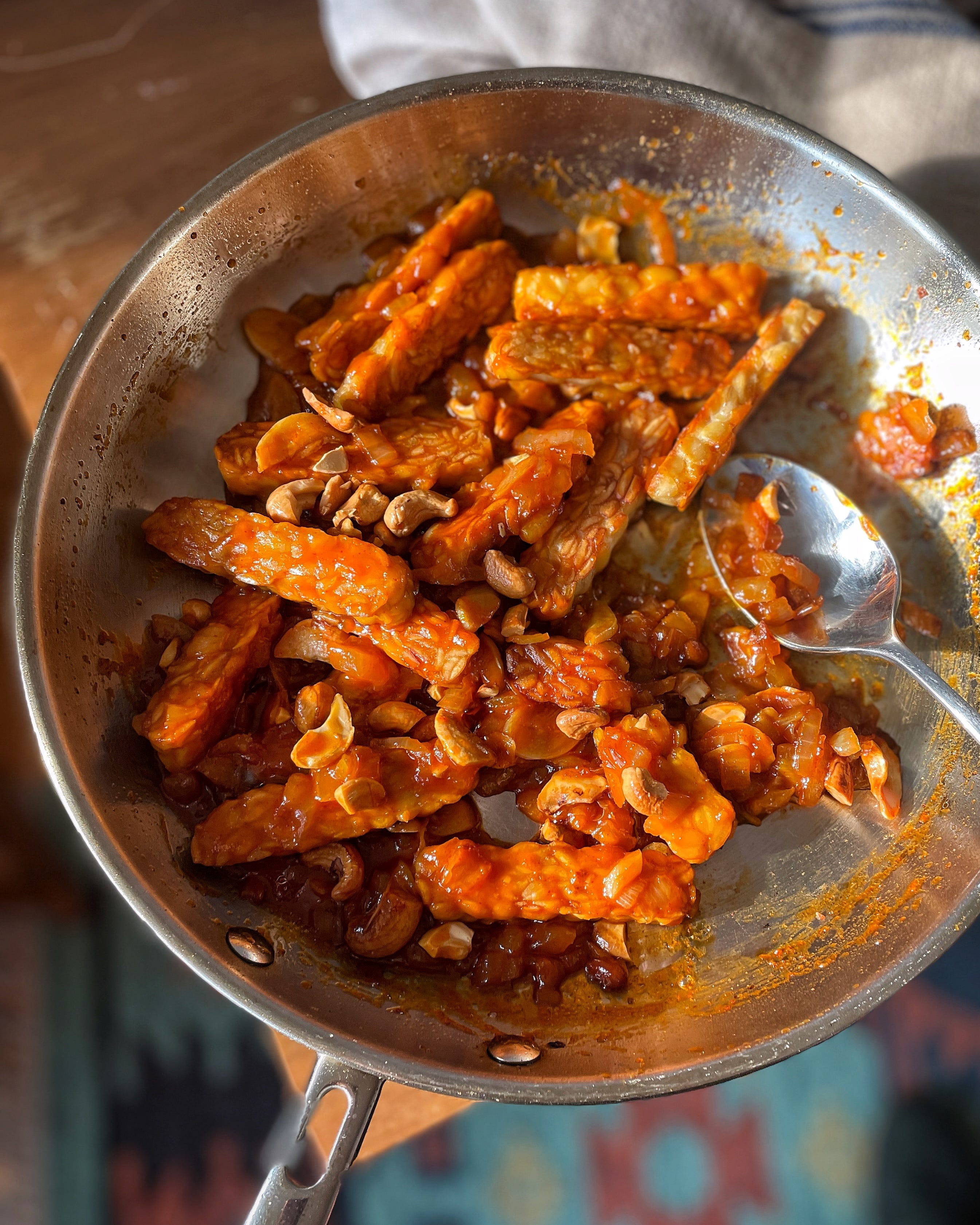
Even though it feels like I drone on about tempeh all the time, it still seems to be the plant-based protein that needs the most love. As I’ve written before, it has a really impressive nutritional offering:

  • High in protein, containing roughly the same amount as beef at 31 grams per cup, and also high in fiber, with 14 grams per cup

  • A great source of vitamin B12, calcium, and magnesium

  • And being a fermented food, it is also extremely digestible

Cooking Tips

I think there is something about both the texture and the flavor that can challenge some eaters, but I personally love the texture — it’s dense and nubby, and its fresh versions have a fresh-mushroom springiness that envelops the soybeans (or whatever grain, bean, or substrate is in the tempeh).

  • Blanching tempeh can remove some of its bitterness, which is more of an issue with grocery store options that aren’t super fresh.

  • Tempeh is quite a local industry — there may be locally made tempeh near you, and I listed many small tempeh makers across the country in this post. It is 100% worth seeking this stuff out.

  • Tempeh can handle (and in my opinion thrives with) bold flavorings. Sweet, spicy, sticky glazes are my favorites.

  • It’s also really good when properly shallow- or deep-fried in a liberal amount of oil, until it’s golden brown and crispy all over. Frying it before coating it in a flavorful sauce is the most delicious way to go.

My Favorite Tempeh Recipes

More Tempeh Recipes


SALT PIG: A Home Cooking Podcast

If you like food podcasts, please check out SALT PIG! It’s light, easy, and meant to be as close to hanging out with a food friend as is possible in an audio format. You can find it wherever you listen, as well as right here on Substack, where we send out a monthly newsletter.


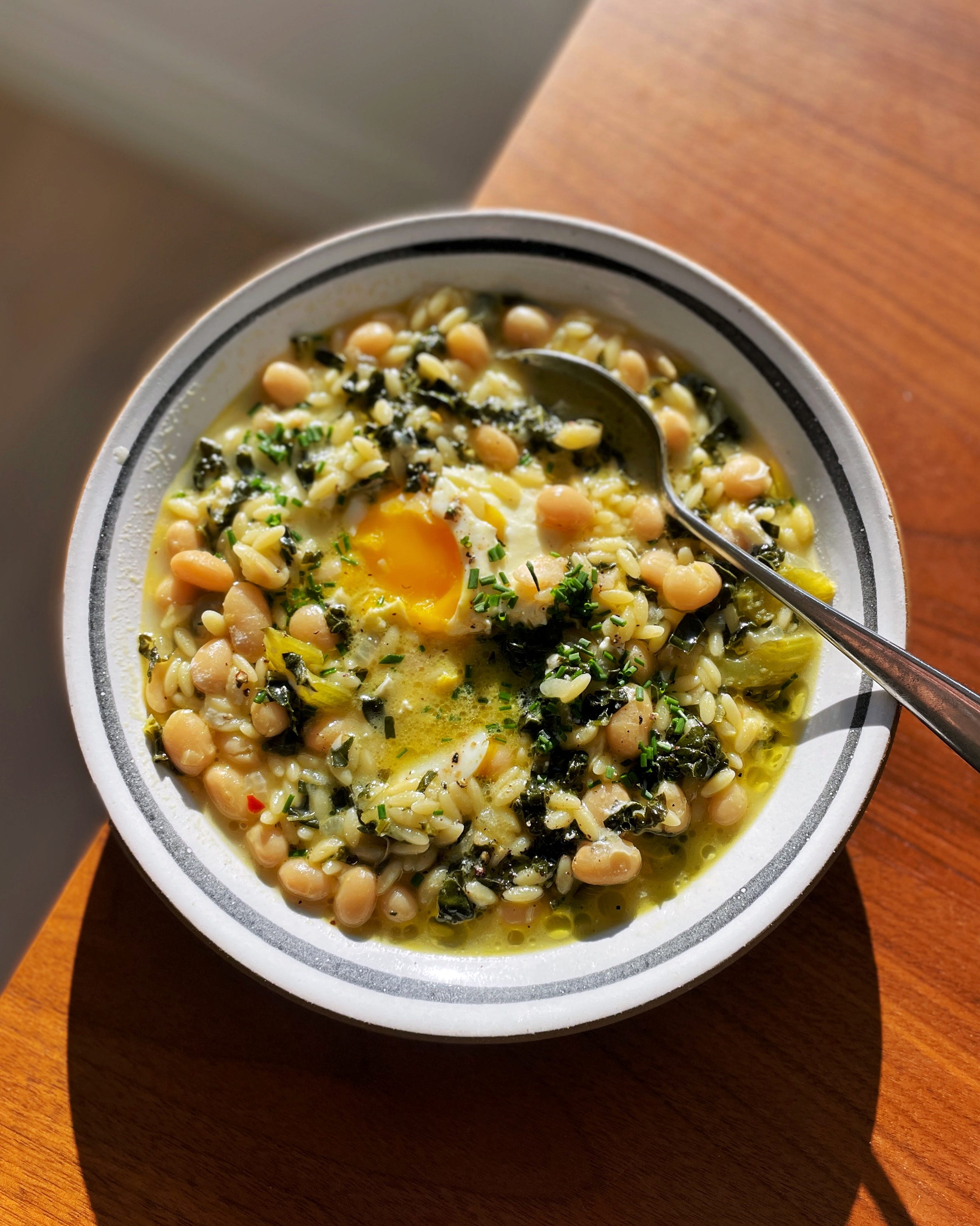
2. Beans!

I know we’re all bean lovers around here. And I’ll bet that many of you are already in the habit of cooking them from dried, since many of us are Rancho Gordo Bean Club devotees.

  • On top of being a low-carbon-footprint protein, beans are also a good source of both soluble (dissolves) and insoluble (doesn’t dissolve) fiber — they feed the gut, and also help to clear it out. Yay, beans!

  • Evidently, the more darkly colored the beans, the more antioxidant-rich they are.

  • Beans are not an “incomplete protein.” This myth comes from Frances Moore Lappé’s Diet for a Small Planet, and she rephrased her point in subsequent editions to clarify that what she meant was beans have low levels of certain amino acids, but the proteins are not “incomplete.” As is always a wise, eat diversely and there’s nothing to worry about.

Cooking Tips

  • When buying canned beans, I always avoid the no-salt ones, because they’re too often a brick of mush. The salt helps the beans hold their shape. If you are avoiding sodium for any reason, obviously ignore this note, but otherwise, for better canned beans, look for salt in the ingredients.

  • On the topic of salt: When I soak beans, I now also salt the soaking water. This has yielded better seasoned, and more “shapely” beans for me.

  • While it is definitely possible to over-cook beans, I always remember something I learned from Gabriella Camara’s book My Mexico City Kitchen, which is that you can take black beans a little over the line, because they will firm back up as they cool.

  • A slow cooker is a great, hands-off way to cook beans (even in the winter).

My Favorite Bean Recipes

More Bean Recipes

3. Tofu!

I can’t live without tofu, and I’m guessing many of my readers feel the same. It used to be that I saw tofu’s selling point as its blank-canvas versatility, how it can be used as a receptacle for whatever flavor you throw at it. But now I want the tofu to live in the spotlight, and to appreciate its delicate fresh flavor and range of textures.

  • All tofu—from silken to extra-firm—is essentially the same product, just with different amounts of water extracted. I eat a fair amount of extra-firm tofu because I find it to be the most substantial and satiating as the primary protein in a meal (a 16-ounce block has between 45 and 50 grams of protein), but I adore the softer, jigglier texture of firm and silken varieties, too.

  • Like tempeh, it’s so worth seeking out fresh, locally made tofu. This is where you’ll really experience the delicate flavor, and also a more interesting range of textures. I was just telling a friend about a grocer near me that sells baskets of tofu cakes, stored in water in a big container that you’d fish them out with tongs. Cheap, incredibly fresh, incredibly good.

Cooking Tips

  • When roasting or searing tofu, dust it in arrowroot powder or cornstarch first to help give it something of a crust and to encourage your seasonings to stick.

  • Blending silken tofu into soups and sauces is a terrific way to create creaminess without dairy.

  • Blanching tofu in salted water is also a great way to gently change its texture, making it bouncy and better at holding its shape. I like doing this for mapo tofu, and in Hetty’s sesame broccoli, tofu, and butter bean salad.

My Favorite Tofu Recipes

More Tofu Recipes

I’d love to hear about your favorite recipes that use these proteins — please share in the comments!

Leave a comment

Read the whole story
rocketo
21 hours ago
reply
seattle, wa
Share this story
Delete
Next Page of Stories