prodigious reader, chronic forgetter
4474 stories
·
13 followers

Minneapolis Responds to the Murder of Alex Pretti : An Eyewitness Account

1 Share

On Saturday, January 24, an ICE agent murdered Alex Pretti in Minneapolis. Five agents tackled and beat him, then an agent shot him multiple times. Video footage from multiple angles confirms that the agent shot Pretti after he had been disarmed. Immediately following the murder, the Whittier neighborhood rose up and battled ICE, Minnesota police, and Minnesota State Troopers for over four hours, eventually forcing them to withdraw.

This murder occurred one day after a historic general strike in which more than 100,000 workers in the Twin Cities walked out against the ICE occupation. Many people in the streets expressed the opinion that the federal agents murdered Alex as an act of revenge for the strike.

Once again, we note the role that local and state police play in enabling ICE to continue murdering with impunity. Democrat politicians have expressed disapproval of ICE tactics, but they and the police who supposedly answer to them have yet to do anything concrete to stop federal agents from terrorizing, abducting, and murdering.

The following is an eyewitness account from an anarchist in Minneapolis.

I woke up at 9:15 this morning to my phone buzzing over and over. The first text I saw read, “URGENT FROM WHIT/UPT IN FRONT OF GLAM DOLL DONUTS: Someone has been shot by ICE.” I groggily squirted some caffeine syrup into my water bottle as I processed this information. I threw on five layers of clothes, a pair of goggles, and a mask, called in sick to my job, and rushed to the scene.

When I got there, there was already yellow crime scene tape up around a three-block stretch of 26th Street. Masked ICE and Border Patrol officers guarded the perimeter, armed with shotguns and pepper spray cans. An ambulance was still there. A crowd circled around the crime scene tape, but did not cross it. A friend recognized me in the crowd and patted me on the shoulder. Someone told me the victim was dead. One person was weeping. Most people were cursing at the feds. An old woman was shouting “You are going to hell!” in the face of a Border Patrol stormtrooper. He was threatening her with a can of pepper spray.

Behind us, on 1st Avenue, three people started rolling a dumpster into the street. An ICE agent fired a tear gas grenade at them. My friend and I started running south on 1st Avenue to get away from the gas. We turned right, then right again onto Nicollet Avenue, bringing us to Nicollet and 26th, where ICE had murdered the man hardly half an hour before. There was a much bigger crowd here facing off against a skirmish line of feds. We recognized another friend of ours and ran up to them.

Just then, we heard the loud crack of flash-bang grenades being fired maybe two or three blocks northwest of us. “We’ll take my car,” our friend yelled. He was parked right there on Nicollet. We piled into his car and he flipped a U-turn and sped away from the ICE agents. We made a few turns and ended up at 25th and Blaisdell.

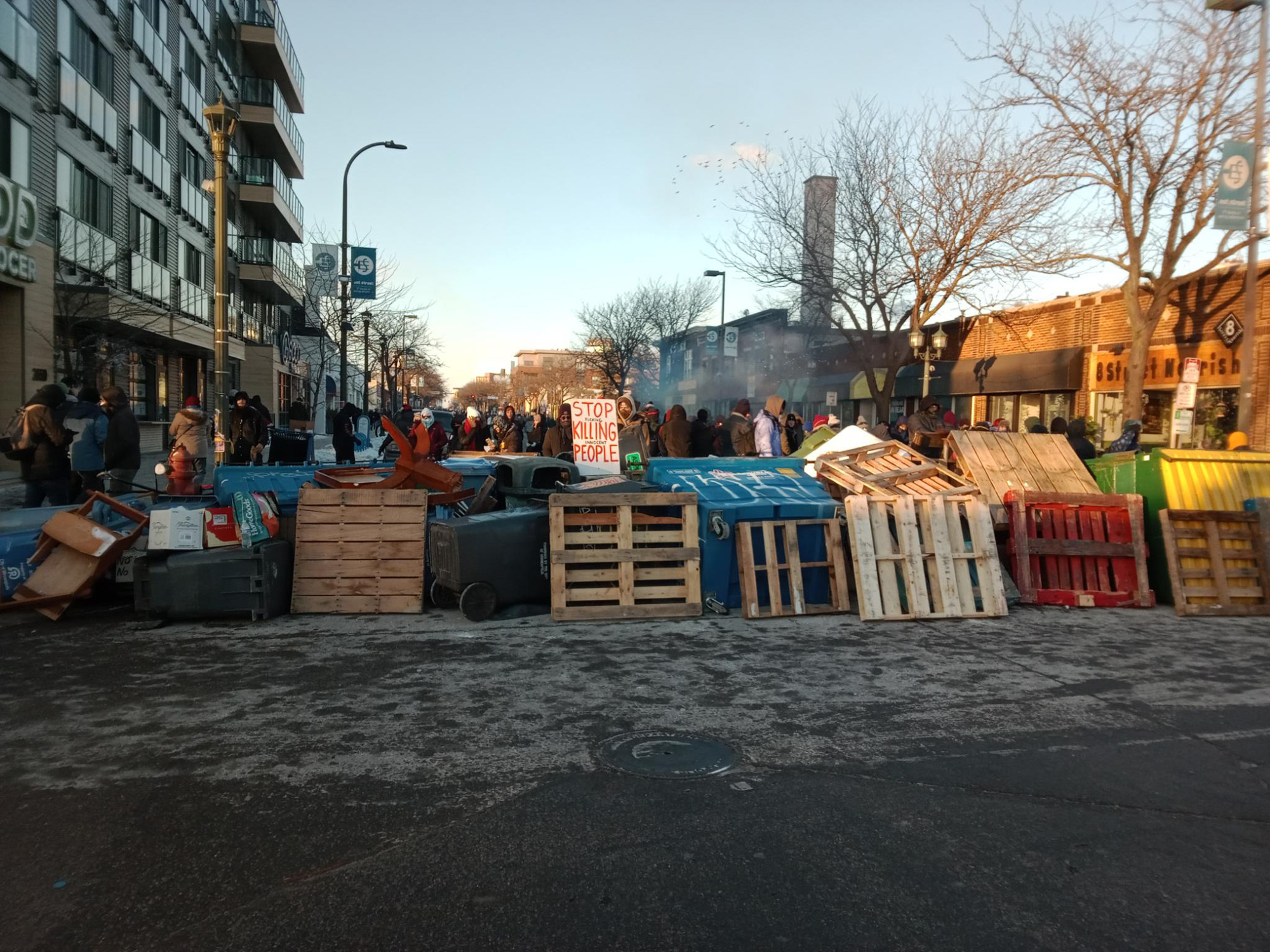
There was a line of MPD Riot Squad cops at the far end, closer to Nicollet. I recognized them by their yellow vests. Between us and the pigs, closer to Blaisdell, a group of people were building a barricade out of dumpsters, trash cans, cinderblocks, and wooden pallets. We heard the ubiquitous call-and-response chants of “FUCK ICE, ICE OUT!” People drummed on the trash cans along to the beat. Someone was sprinkling what appeared to be home-made caltrops in front of the barricade.

As we approached the barricade, people in the crowd started rolling the dumpsters forward toward the police line. Somebody lit one of them on fire. One man was shouting at us, futilely trying to peace-police the crowd, but no one wanted to hear it. A few people promptly escorted him away. Flames engulfed the burning dumpster. People rolled that one forward too.

Flames engulfed the burning dumpster.

The police started shooting tear gas and rubber bullets. Their aim was not particularly good. This was the first time this year that I’ve seen them use rubber bullets rather than pepper balls or gas. The crowd fell back, and the cops charged forward and overtook our barricade. Three of them tackled and arrested one person near me, slamming her to the pavement. I yelled and turned back for a second, but instantly choked on the tear gas and was forced to fall back towards Blaisdell. Some people were chucking glass bottles and chunks of ice at the cops as they retreated.

The crowd pulled more trash cans from the alleys and quickly began building another barricade further back. I had lost track of the person I had driven there with, but soon I found another person I knew. Some began shouting for people to fall back west on 26th and keep building barricades. This ad hoc strategy caught on. People ran down the street leaving trash cans and tires behind them, creating a series of small barricades as the cops advanced.

A woman was watching from her porch. Someone ran up and addressed her: “Ma’am, we’re out here defending the neighborhood against ICE. We need barricade materials. Is there anything in your yard you wouldn’t mind parting with?” She nodded urgently and showed them to her backyard, offering a flower bed, an old couch, and a lawn chair. Three people helped to carry these out and add them to the barricades.

While this game of cat-and-mouse progressed, Signal messages arrived from others who were holding down a different barricade three blocks away, on Nicollet on the south side of the intersection. Our crowd was facing off against MPD, but theirs was facing off against ICE. My friend and I decided to join them. We cut through a series of alleys until we came out on 27th Street.

We ran left onto the stretch of Nicollet full of restaurants that locals know as “Eat Street.” There was a much bigger crowd there standing behind a barricade made mostly of wooden pallets. A skirmish line of ICE and CBP officers stood on the opposite side. We could see the fear in their eyes. It felt good.

No sooner did we approach the barricade than ICE opened fire with tear gas. I’m not a stranger to tear gas, but they fired more than I’ve ever seen. Noxious white clouds enveloped us. My lungs felt like they were burning. Somebody picked up a canister and threw it back. We stampeded south on Nicollet to get out. When I turned to look behind me through the gas clouds, I saw ICE SUVs and a Bearcat armored car leaving the scene, headed east toward the highway.

We ran down to 1st street, where I’d started out, to try to catch the agents as they retreated. We turned and ran north back up to 26th. People were peppering their cars with rocks and ice chunks as they drove off toward the 35W on-ramp. They fired more tear gas and green smoke out of the vehicles as they fled onto the highway.

After people chased off the ICE agents, we returned to 26th and Nicollet from the east. A huge number of state troopers were lined up on one end of 26th, facing the protesters on the other side. They had an LRAD on top of a Bearcat. One of the cops was reading a dispersal warning over a loudspeaker.

“SHUT THE FUCK UP!” one person shouted back.

“TRAITORS!” screamed someone else.

The state troopers launched a barrage of tear gas and flash-bang grenades at us. Someone threw a powerful firecracker back at them. It exploded at their feet.

The crowd hurried back and turned left onto another street. Everyone was exhausted from a long morning of activity; many were starting to move more slowly. I saw the state trooper vehicles speeding away through their own cloud of tear gas, just as the ICE agents had done. It took me a minute to realize that they were gone.

I ducked out of the ongoing protest. It was high time to buy a real gas mask. I went to a hardware store and picked up a big pack of hand-warmers to give out to the crowd. It wasn’t until my adrenalin eased up that I realized I hadn’t eaten yet. I was famished.
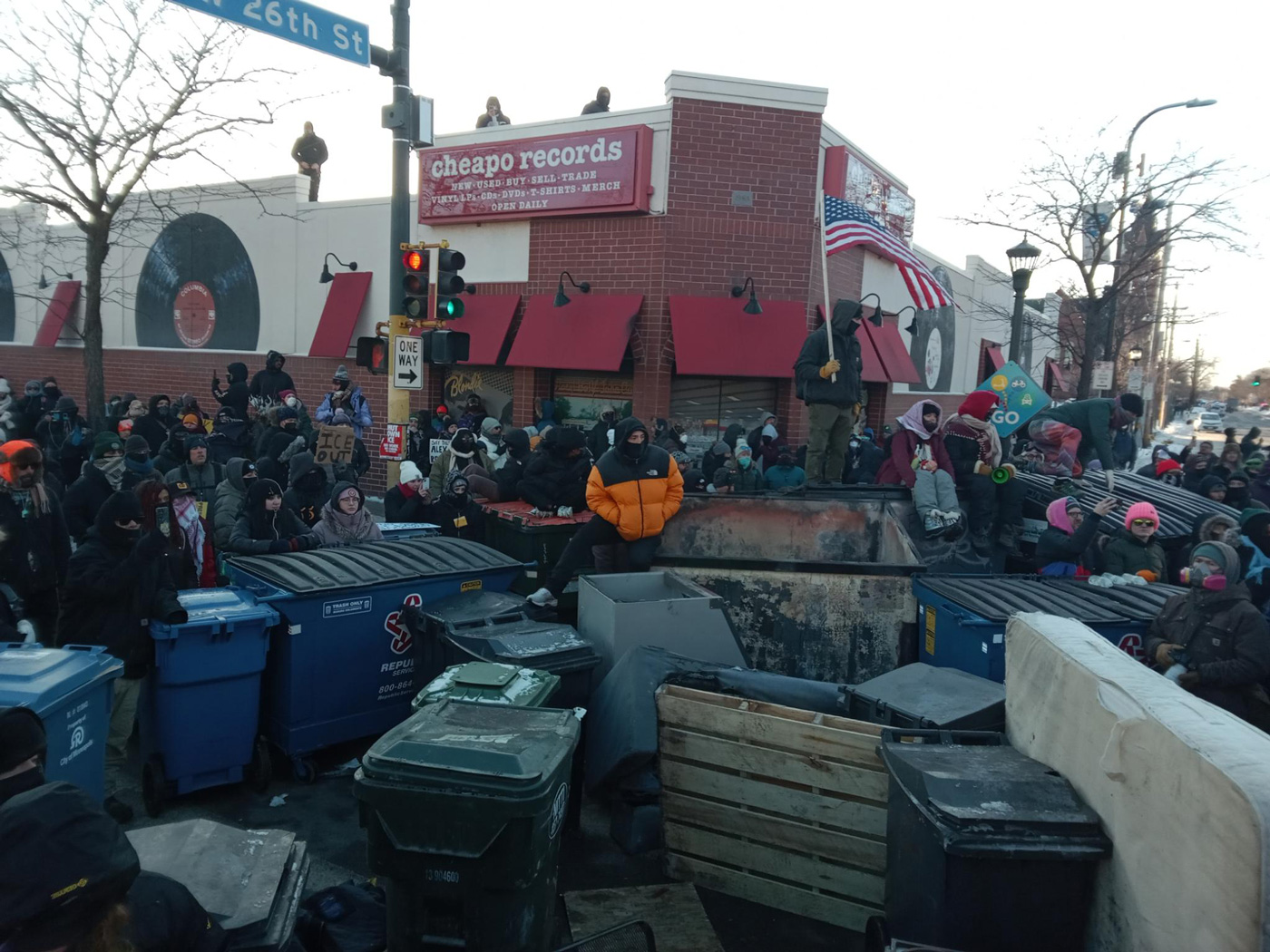
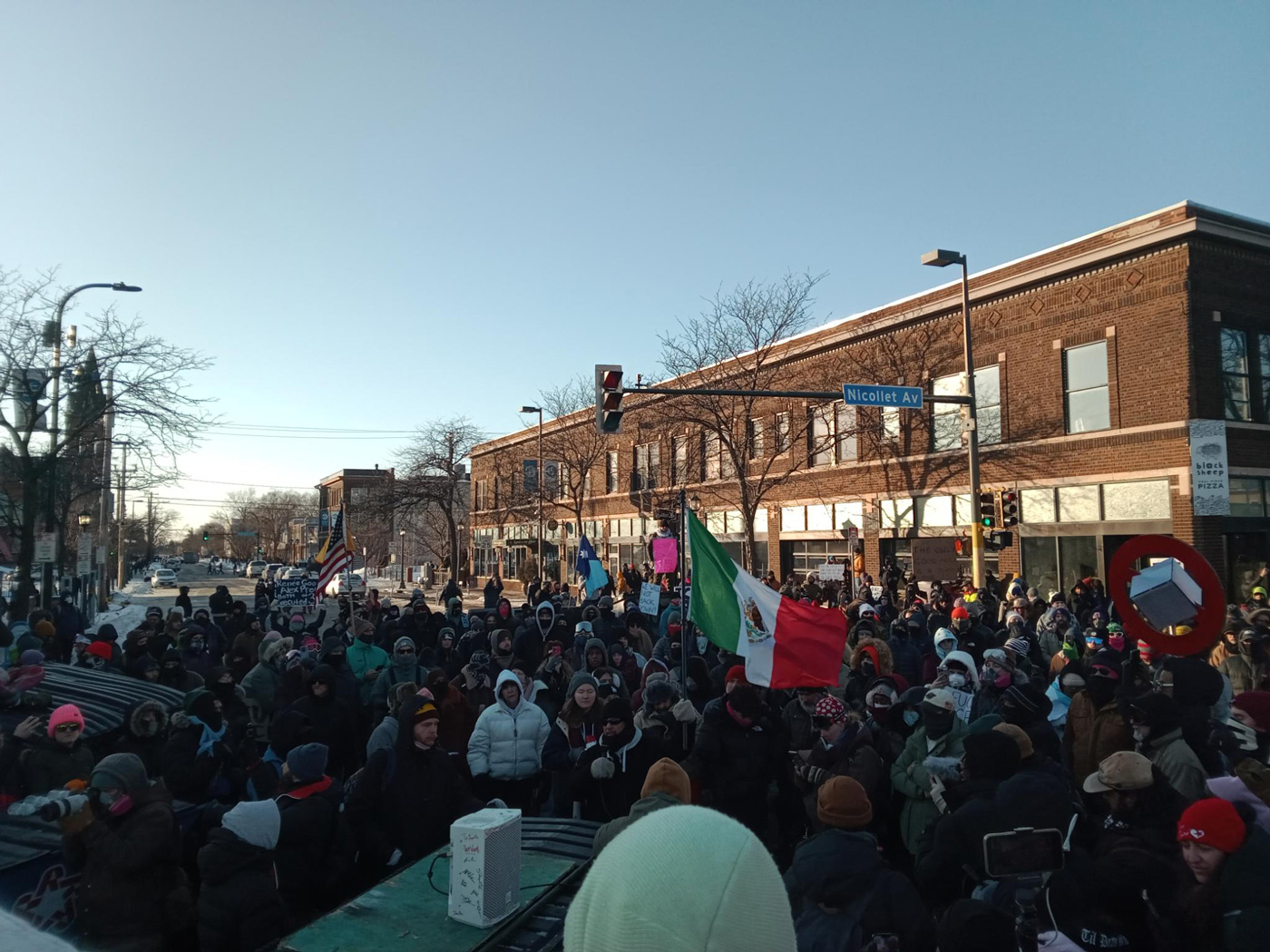
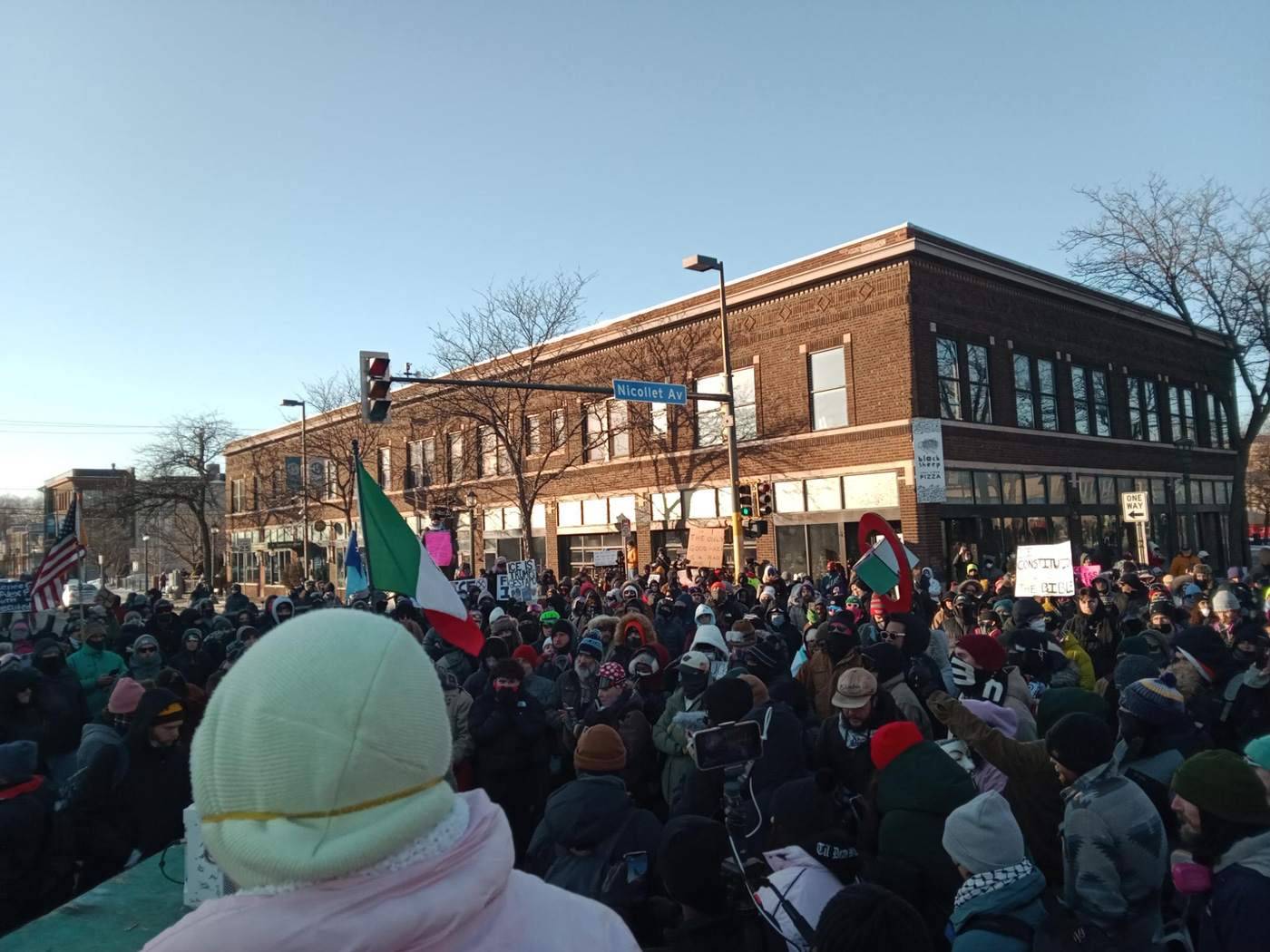
I returned to the site of the murder about 45 minutes later. A massive crowd of well over 1000 people had gathered, filling up a whole city block. It reminded me unmistakably of George Floyd Square. The block that was once Eat Street had transformed into Alex Pretti Square.

It appeared that all the little barricades that the people of Whittier had erected had been relocated here, blocking off Nicollet at both ends. People sat on top of dumpsters, drumming on the lids. The crowd looked more racially diverse than I’d ever seen that neighborhood before. A Mexican flag was waving near the middle of the crowd.

A young woman produced a PA system in the middle of the crowd. Everybody circled around it as people took turns making speeches.

A young man took the mic. He couldn’t have been more than 20.

“Y’ALL. NOBODY IS COMING TO SAVE US. WE MADE HISTORY YESTERDAY. WE WENT ON GENERAL STRIKE. WE SHUT DOWN THIS WHOLE FUCKING CITY. THAT’S THE BEST WEAPON THE PEOPLE HAVE, WE’RE THE ONES WHO MAKE THE WORLD RUN AND WE’RE THE ONES WHO CAN MAKE IT STOP. BUT ONE DAY’S NOT ENOUGH. WE GOTTA KEEP IT GOING INTO MONDAY.”

The crowd broke out into thunderous applause, cheering and drumming rhythmically on the dumpster lids.

The young man started a chant: “NO MORE MINNESOTA NICE! MONDAY MINNESOTA STRIKE!”

It echoed across the square.

The ICE invasion of the Twin Cities has long since passed the point of no return. It is unthinkable that society could return to “normal” after what we have seen and felt. The powers that be know very well that they have to play for keeps now. So do we.

Today, at the Battle of Whittier, even through the tear gas, we could taste a softer, gentler future to come. These federal murderers know it, too. We will bury them beneath the new world in our hearts.
Read the whole story
rocketo
14 hours ago
reply
seattle, wa
Share this story
Delete

rejecting a life without people

1 Share
Solidarity to the people of Minnesota. They are fighting back against the oppressors invading people's homes and kidnapping children. Solidarity also to the people of Minneapolis. Many residents are participating in a general strike today. They're taking direct action and putting their lives, families, and livelihoods at risk.

Visit Stand With Minnesota to send support to people harmed by ICE and for everyone defending their neighbors.
rejecting a life without people

This is the sketchbook version of the AI policy I am writing for my consulting firm, Future Emergent.

Future Emergent envisions a world where everyone treats every being with care and dignity. Creativity, clarity, and connection are the values at the heart of everything I do. It's hard to fake these values. Nobody can replicate the ingenuity and insight that is unique to humans. Nothing can replace the compassion and empathy we have for each other. We all play a role in creating a just society. We deserve to belong even if our worth is not obvious to the powerful.

Artificial intelligence (AI) has high value in a capitalist system like ours. Companies "succeed" when they have exploited and eliminated as many workers as possible. AI also offers consumers a frictionless and convenient future. The AI industry wants us to consider it our friend, therapist, taxi, and toy. Billionaire and millionaire investors have sunk countless amounts of cash into AI. AI promises a world that seems appealing to both business and consumer interests—a world without humans. But AI won't replace humans. AI can only displace them.

AI is less than a decade old but we know the environmental and psychological damage it can cause. We know that data centers bring even more harm to the communities not powerful enough to fight them. It's true that many of the comforts in our daily lives cause harm to people and communities. I try to resist those too whenever I can. For me, the total cost of AI does not outweigh whatever benefits it may bring. It's a wasted investment; a cost I don't have to sink.

AI at Future Emergent

AI is a tool I choose to use as little as possible and always with intention. AI can never replace the decisions I make as a consultant. In its current state, there is little that AI can do that I can’t do better. By using AI, we train it to better mimic (but still not replace) our work. I choose not to take part in that.

  • I won't use AI to create reports, conduct research, or make recommendations.
  • I refuse the use of all generative AI in the work I deliver to my clients.
  • I will continue to contract and work with humans whenever I can.

I use an AI tool to transcribe most of the meetings I facilitate or take part in. This software helps me locate direct quotes or topics that come up in these sessions. I will never share the output of this tool with a client or community member.

The decisions we make about the ethical and moral stances we hold will always be personal. AI may have appropriate uses for other people in other jobs or industries. It just doesn't hold value for me. I don't need it to create the world I want to live in. I would rather have a life full of people.

the appeal of AI

I wanted my AI policy to be concise and straightforward for clients and colleagues alike. The text above and the references below will live on my company's website. But I've spent several weeks thinking about this and my last post on AI. I wanted to sort through my thoughts a bit more before I close this topic for a while.

I think for most people, AI is a "why not?" tool. It's already on the app or website we were using anyway. I used a chatbot this week when my accounting app's help desk replaced its search function with one. For other folks, AI is more like a novelty or toy. My weather app has an AI "chat" feature that gives snarky replies to questions. I used it once or twice and lost interest. These kinds of uses feel like a passing phase. I bet they'd disappear if AI became more expensive or went away altogether. There are two groups of AI users that I'm most worried about.

AI is now beginning to act as a therapist or health professional. Or it tells people they're always the wronged one in a relationship. It tells kids that they're better off dead. I don't see how AI companies will solve these problems. OpenAI made their GPT less sycophantic in a newer update and their users revolted. As many have noted in contrast, the u.s. government banned lawn darts after it killed just 3 kids. What makes AI special enough to dodge that kind of scrutiny?

I'm also worried about the folks who see AI as a tool that does work "better" than them. It rewrites the tone of their emails to seem friendlier. It composes the "perfect" fan letter to an athlete. I think about the level of stress on most people these days. Is AI successful because it makes the boring parts of our jobs easier? Does it write a better email than we do when we don’t care about sending a stupid email? Does it matter that our email isn’t creative—isn’t a work of human ingenuity—when the recipient will skim its contents between meetings anyway? Do people feel like something, anything would be better than their best?

AI users like these came to mind when I read an essay by Karen Maezen Miller earlier this month. She writes that the teacher Maezumi Roshi was fond of saying, "It is impossible not to do your best. You just don't think it's your best." I started to wonder if AI was exploiting people's insecurities the way other products do. If AI produces results that are "good enough," why isn't the "good enough" of people, well, good enough?

I know that there's plenty of conflicting facts about AI, and that I have some bias against it. If it's any defense, I still say "thank you" to Siri when it tells me if the restaurant I want to go to is open. I hope that's good enough for now.

references

I based my policy on the resources below. Check them out for more information.

Keeping Bandcamp Human, Bandcamp

Why we created (and abide by) an AI Policy, Work in Progress Consulting

A Tool's Errand, be the future

Read the whole story
rocketo
14 hours ago
reply
seattle, wa
Share this story
Delete

Hate Has to Scatter When Minneapolis Arises

1 Share
Minneapolis, Minnesota. January 23, 2026.

“NUREMBERG IS COMING.” It was not so much the sign itself, black block letters on plain white cardboard, as the contrast between the sign and the man holding it: White, mustached, middle-aged, well-dressed, strolling alone on a downtown Minneapolis street.

“NUREMBERG IS COMING.” This represents not the radical, but the median view of the regular folks in Minneapolis towards our current federal government. This is the average view of the normal middle-aged guy in the office. This helps to explain a lot of things. January 23, for example. When the temperature creeps down towards -20, as it did yesterday, being outside becomes difficult. Glasses fog over into an opaque film. Ice crystals form on men’s beards and the downy, transparent hairs on women’s faces. Warm breath condenses on the scarf covering your mouth and then freezes into an ice sheet that loses its utility. Toes begin freezing the second you step outside and take hours to defrost. Even in thick gloves, hands begin freezing as soon as you withdraw them from your pockets, so that even the act of holding a sign at all requires great commitment. Thighs freeze, knees freeze, eyelids freeze, the tiny spot on your forehead that your hat can’t reach freezes. You yearn to be covered in a full-body suit made of hand warmers. I had 11 hand warmers on me yesterday, stuffed in various pockets and socks, and it was not nearly enough.


Subscribe now


So—good day for a general strike? Good day to march outside for hours on end? Well, the question is relative. Normally, no. But if you are living in the sort of times that cause sober people to believe that Nuremberg is coming, you might make a special exception.

Was there a general strike in Minneapolis yesterday? I have no idea. That’s like asking a man in tiny sailboat in the ocean to name the exact dimensions of a hurricane. Hundreds of businesses shut down thousands of union members stayed out of work and tens of thousands of people joined the day of action against ICE. A number of people in other places remarked that this goes to show that Minnesotans are simply immune to the cold. I think not. Nobody is immune to that cold. That’ll kill you. They just had larger priorities. The famed “Minnesota Nice” attitude was repurposed on many signs into “Minnesota NOICE.” Others carried, simply, flattened packages of ICE NO MOR brand Ice Melt, unadorned with anything else. ICE is a plague, yes, and a deadly one, but the city stood up to declare: We know how to deal with you.

By 9 a.m. Friday, people were trickling off the light rail and tottering their way down a frozen sidewalk to take their place across from the Whipple Building where ICE is headquartered. The protest area there is a blank canvas for expression. Two men yesterday morning had megaphones. One was somberly reciting the text of the Declaration of Independence. The other was screaming “Fuck you, pussy bitch!” at the agents’ SUVs as they drove past. All bases were covered.

An hour later, one stop away at the Minneapolis airport, hundreds and then thousands of people streamed into Terminal 1 for a major protest planned by a coalition of unions. A team of police stood calmly strapping on their riot gear as the terminal filled with protesters bundling up to face the outdoors. We all filed outside and formed an enormous picket line that stretched hundreds of feet, the length of the entire terminal sidewalk. The fact that everyone was draped in heavy coats and had their faces wrapped served to emphasize that this was not a march of some faction. This was everybody. This was the people, chanting “ICE Out!” and calling on Delta and Signature Aviation to cease their cooperation with the deportation machine. Union members in yellow vests served as marshals to keep people in line. A circle of younger students locked arms and held a sit-in in the area where passengers walked in to catch their flights. And something like 100 clergy members, draped in stoles over winter coats, knelt down in the road outside the terminal and were arrested.

Nuremberg is coming, and god is on our side.

By 1:30 that afternoon, thousands and thousands of locals—some who had already been to the airport and back—were making their way to The Commons, a large park in downtown Minneapolis, set amid high-rise towers and the gleaming, angular stadium where the Minnesota Vikings play. People risked frostbite to hold up signs and upside-down American flags attached to hockey sticks. Somewhere in the middle of the park was a stage, and a speaker, but due to the gentle hills in the park, neither I nor at least half of the people there could see any of that.

It didn’t matter. The importance of all of those people in that park on that frigid day was not the speeches nor the signs nor even the enormous march they were about to make through the urban canyons of Minneapolis. Instead, I think, it was their own manifestation of a way of being that is different from the fear, division, hostility, and revenge that ICE embodies. That park was instead a place of love, of unity, of openness, of commonality. People wandered around passing out free hand warmers and snacks. People made way for one another, politely. People there were, collectively, willing to inconvenience themselves, to undertake some level of sacrifice, in order to help their neighbors who were in even greater need. Yes, I will take off work, and I will close my business, and I will follow around federal agents in my car, and I will freeze my ass off in to protest on the coldest day of the year, because the outrages being perpetrated against my neighbors is important enough to warrant that. That is what the day represented. As much as we dream of general strikes as the magical solution to our biggest problems, there will always be a morning after the general strike, and the problems will still be there. What will eventually grind those problems down is the sustained determination of the people to sacrifice for one another.

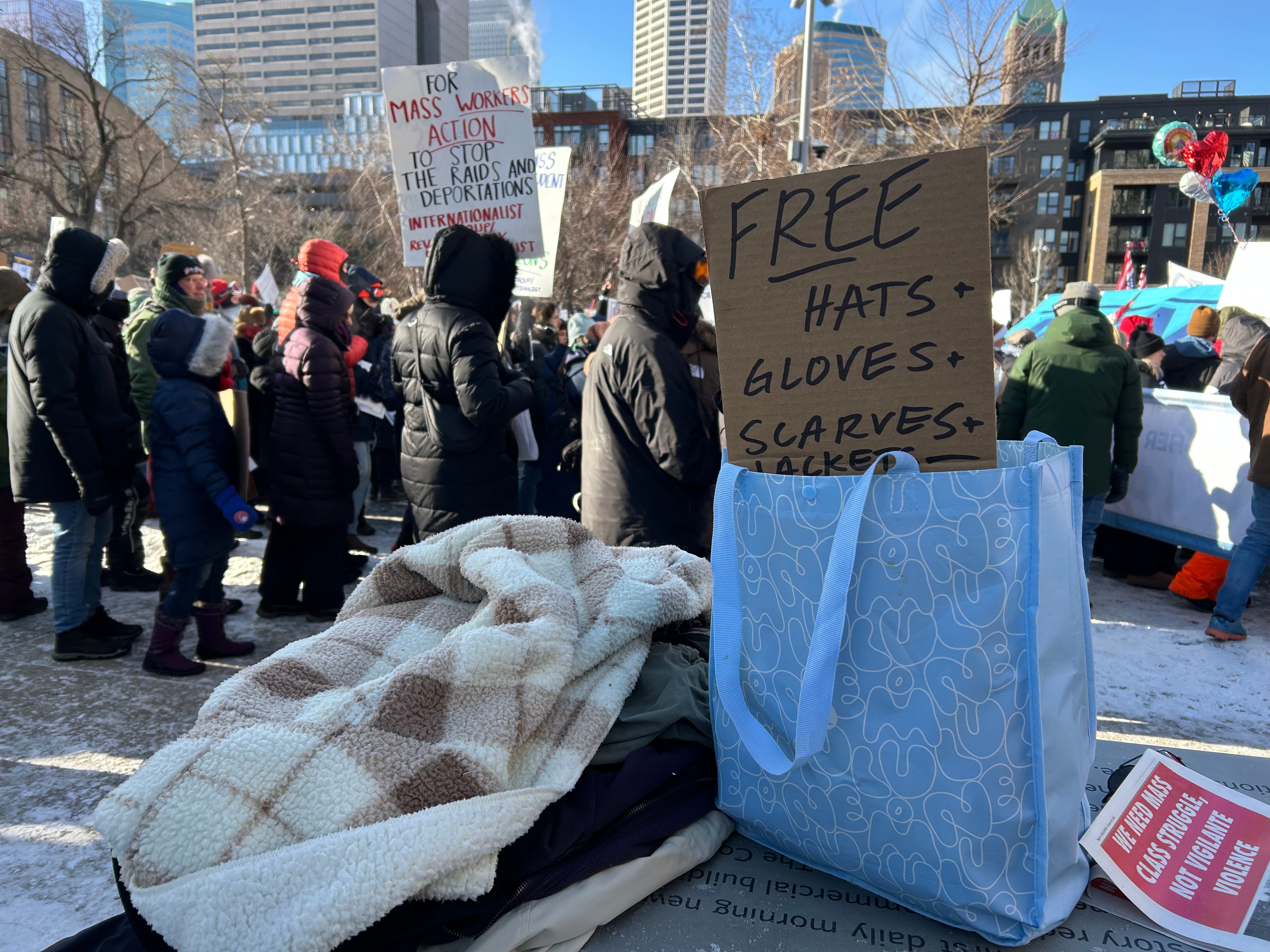
In the middle of the park, amid knots of protesters, was a table piled with clothes. A handwritten sign read, “Free Hats + Gloves + Scarves + Jackets.” You could have wandered into that park naked and found yourself an entire winter outfit, along with hand warmers and hot chocolate, before you died of exposure. I don’t know who brought all that stuff out there. People brought it, for other people. That’s what I saw in Minneapolis. The extended hand of niceness, and the way that it can form a protective fist, when it needs to.

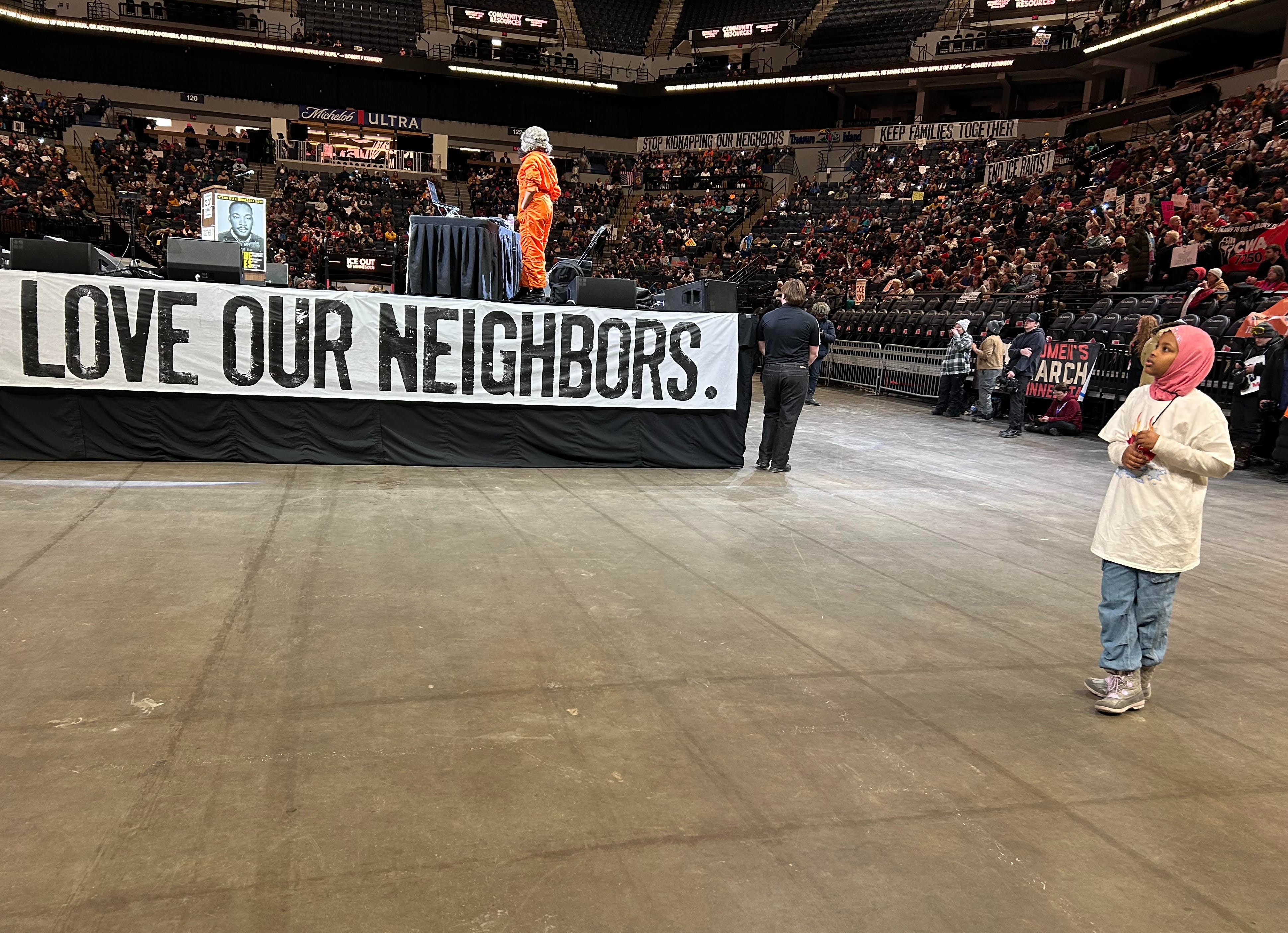
The march was big. It was officially announced as 50,000 people. Privately, some organizers said it was more like 100,000. I can only tell you it was big. The march ended at the Target Center, the downtown basketball arena, which organizers had secured at the last minute, when it became clear just how brutal the weather was going to be that day. A great DJ in a head-to-toe orange snow suit and fur hat mixed Kendrick Lamar with “Dancing Queen” as people filed in slowly, eventually filling the stadium’s entire lower level. It was kind of neat to see “ICE OUT OF MINNESOTA” displayed as the message on the huge overhead screen at an NBA stadium, in the place that normally shows Anthony Edwards dunk highlights. In the video crawl around the arena normally reserved for local ads and announcements, there was a rotating series of handpicked, appropriate slogans: “‘Resistance to tyranny is service to God.’ - James Madison.”

There was a benediction by a Native American professor, and music, and a speech by an imam, and another by a Christian pastor, and more by union leaders. It was, I realized, a tableau of the city of Minneapolis itself, and of the ethos that the entire day was putting forward. It was a suggestion of a way that America could be, a way better than what we are doing now. Here they say “Minnesota nice” and in New Orleans they say “Be nice or leave!” and in every other city they say their own variety of this, and all of it is just a way of saying that we can be open rather than closed, that we can welcome neighbors rather than despising them, and that we can, if necessary, fight to be nice just as hard as others can fight to be mean.

“To our migrant community,” the imam said, “You are not garbage. You are gorgeous. You are not foreign. You are familiar. You are not far away. You are our future.”

All types of people live up here, in this frozen city. Minnesota, for some reason! The most vibrant Somali community in America. One of the richest traditions of organized labor in America. The cradle of our generation’s racial justice movement. All here. To visit here is to be impressed by how many people in this city are willing to rise up to protect it from those who see all of its characteristics as a threat, rather than as a blessing.

This is a city full of socialists. This was a general strike organized with clear-eyed political and economic goals. But, I must admit, it was the religious man, the preacher—B. Charvez Russell, of Minneapolis’s Greater Friendship Missionary Baptist Church—that summed up the feeling of January 23 most effectively.

“This is not a call to violence,” he thundered from the podium in the middle of that arena. “But it is a declaration that when god moves, there is no room for the enemies.”

“When god rises, hate has to scatter.”

“When god rises, fear has to scatter.”

“Lies have to scatter!”

“Injustice has to scatter!”

“Division has to scatter!”

“Oppression has to scatter!” “

“Families being intimidated has to scatter!”

“Children being traumatized has to scatter!”

“Workers and labor being labeled as enemies and threats, all of those have to scatter!

“Renaming an invasion as protection has to scatter—when god arises!”

Leave a comment


Also

  • Previously: Cold City, Hot Heart.

  • Find out how to support the people of Minnesota here.

  • It is your paid subscriptions and donations that enable me to do this reporting. If you’d like to support How Things Work in 2026, take a quick second to become a paid subscriber today. Thank you all for reading.

Subscribe now

Donate to our reporting fund.

Read the whole story
rocketo
18 hours ago
reply
seattle, wa
Share this story
Delete

the past three weeks in a row, partner has gone to chipotle and been served by the same employee…

1 Share

audhdspacewizard:

json-derulo:

json-derulo:

json-derulo:

json-derulo:

json-derulo:

the past three weeks in a row, partner has gone to chipotle and been served by the same employee who, in bold defiance of the testimony of his own eyes and ears, ardently refuses to believe carnitas exist

partner: “Hi, could I please have a bowl with white rice, black beans, and carnitas?”

employee (completely blank expression): “No.”

partner (autistic) (socialscript.exe encountered an unhandled exception) : “…Uh. Um. Sorry?”

employee: “We don’t have that.”

partner (wondering if perhaps he put too much of the authentic accent on the word and that’s what’s throwing the guy): “You don’t have…(pronouncing it whiter) carnitas?”

employee (face still unreadable): “No.”

partner (looking at the near-full hotel pan of perfectly normal carnitas in its usual place on the other side of the glass) (noticing this employee looks unfamiliar) (maybe he’s a new guy that just started five minutes ago with no training?) : “The…pork?” (pointing at it)

employee: “We don’t have pork.”

partner (beginning to wonder if he’s the one that’s losing it) (desperately looks to the menu on the wall behind the employee) (the menu lists carnitas as a protein option) (the word “carnitas” is not crossed out or taped over or otherwise adulterated) (carnitas have been on the standard menu since at least 2016) : “Okay. Um. Are you…sure?”

other employee working the toppings part of the line (familiar) (have seen her before) (she has cool earrings): *gives the new guy a strange look, nudges him aside, and scoops the carnitas onto partner’s bowl before continuing with the other toppings*

Repeat conversation again the next week. And the next. Same guy. If it’s a bit, no one is laughing, including the employee.

theories I’ve considered:

- the employee keeps very strictly kosher/halal/vegan and refuses to handle pork (understandable, I respect that, but if you’re gonna work at a place that serves pork I do kinda feel like when someone orders it you’ve just gotta tap in a coworker to do it for you)

- someone did something gross to the carnitas and the employee is trying to warn people not to order it (??? throw it out then? also, three weeks in a row???)

- the employee is a space alien who views humans as so similar to pigs that for us to eat them is tantamount to cannibalism

- the employee is the lead in a kdrama romance about a pampered, clueless chaebol heir who is sent by his father to work in the company’s restaurants for a year in order to prove he’s ready to take over as CEO. he’s dumb as rocks but they can’t fire him or even correct him that harshly due to the power gradient. partner is just a minor reoccurring character, and the interaction is kept the same from week to week to highlight the development of the relationship between the employee and his love interest with the cool earrings (even if the restaurant is literally a fully-branded Chipotle, that’s somehow still not enough product placement for me to believe this is a real kdrama)

After reviewing again with partner, evidently I forgot a detail that set this week’s carnitas denial dance apart from the others.

partner (well aware of what he’s getting into with this guy now): “Hi. Could I please have a bowl with white rice, black beans, and pork?”

employee: “We don’t have pork.”

partner (demonstrating a level of patience only a public school teacher could have): *points at the pan of carnitas* “Could I please just have some of that?”

employee (after several slow, confused blinks): *points at the same pan* “That’s steak.”

partner (looking at the hotel pan they’re both pointing at) (it is filled with shredded meat of a pale beige color) (at the other end of the row of pans is another pan containing dark brown, lightly charred meat chopped into small pieces): “Okay.” *deciding he’s willing to play in this fantasy space if it gets the job done, he points at the first pan again* Then could I please have the steak?”

employee: *starts to reach for the pan at the other end containing the actual steak*

partner: “Oh—no, sorry, this one please?” *points at the first pan containing the carnitas*

employee: *blinks, then just walks away and starts helping the next customer in line, leaving partner’s bowl unfinished*

other employee with cool earrings: *rolls her eyes at new employee, takes partner’s bowl, and fills it with carnitas herself*

new theories:

- the employee is a bridge troll who will only dole out his delectable carnitas to those who prove themselves worthy by correctly answering his riddles three

- the employee is stoned out of his mind at all times on a specific strain of weed that totally erases the concept of pork from his memory and awareness

My dealer: got some straight gas 🔥😛 this strain is called “pork eraser” 😳 you’ll be zonked out of your gourd 💯

Me: yeah whatever. I don’t feel shit.

5 minutes later: dude I swear I just saw some steak in the hotel pan

My buddy Phillip pacing: Chipotle upper management is lying to us

Read the whole story
rocketo
18 hours ago
reply
seattle, wa
Share this story
Delete

Protesters Blockade ICE Headquarters in Fort Snelling, Minnesota : Report from an Action during the General Strike in the Twin Cities

1 Share

On January 23, thousands of people went on strike in the Twin Cities to oppose the ongoing campaign of kidnapping and murder that federal mercenaries have perpetrated over the past two months in service to Donald Trump’s program of ethnic cleansing. Over 1000 businesses shut down—some enthusiastically, others involuntarily. At the same time, a smaller number of demonstrators set out to prevent federal mercenaries associated with Immigration and Customs Enforcement from carrying out the abductions they had planned for the day.

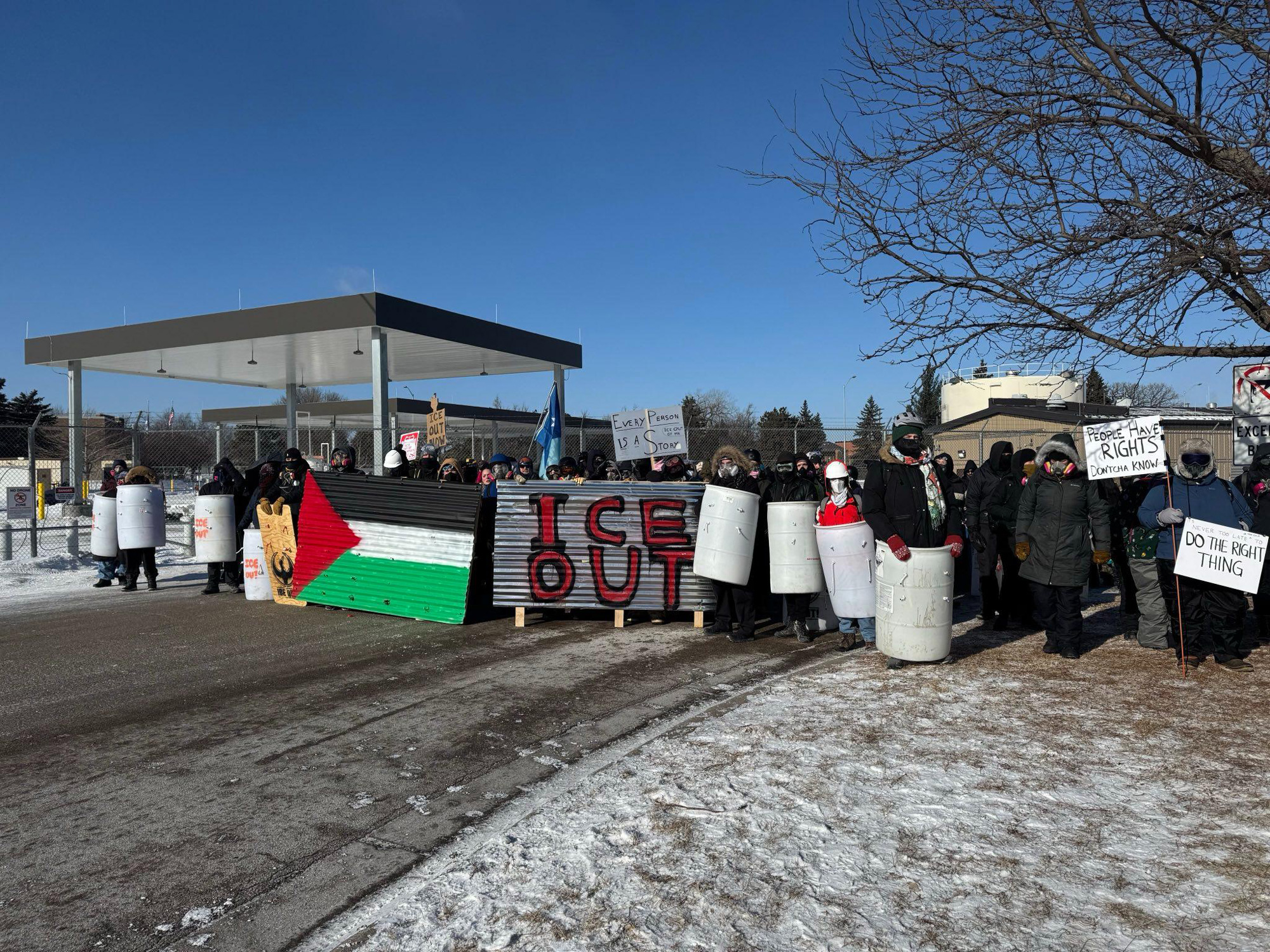
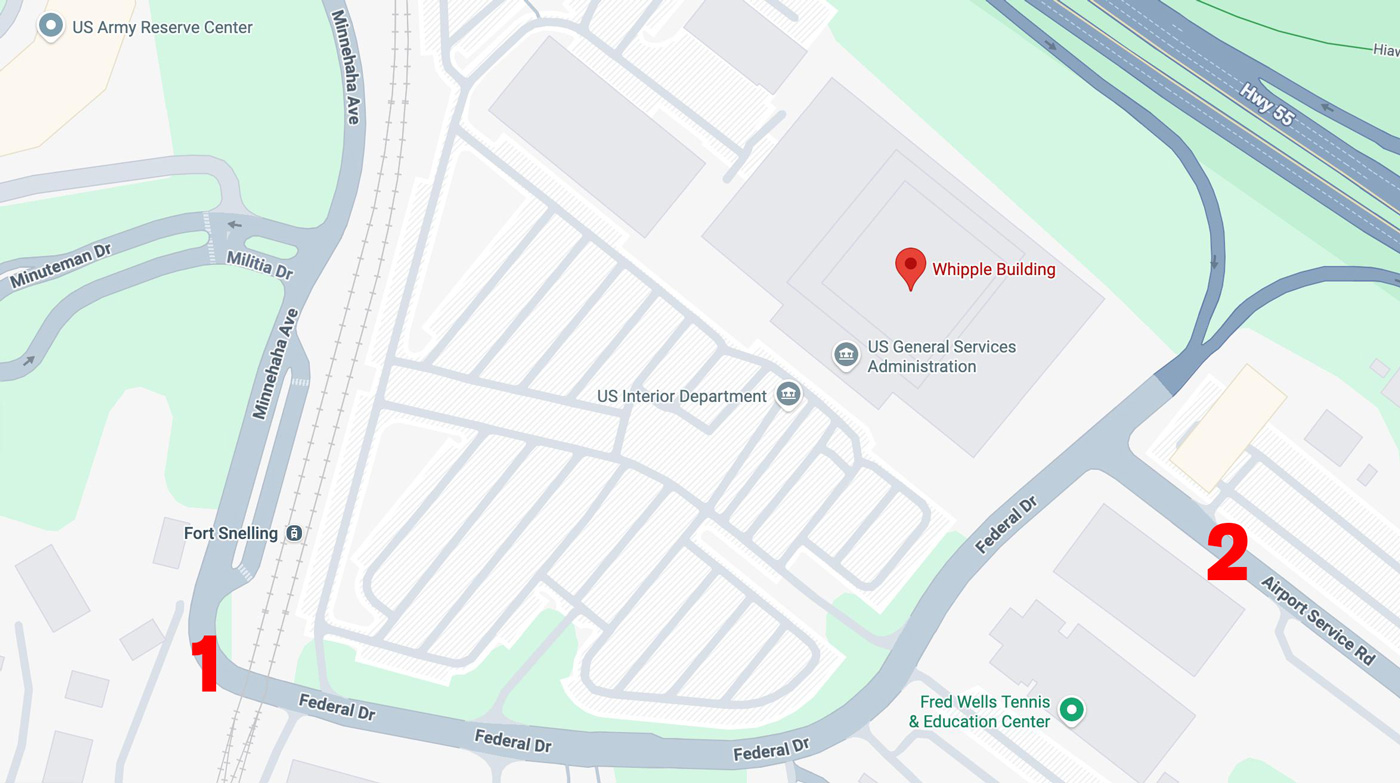
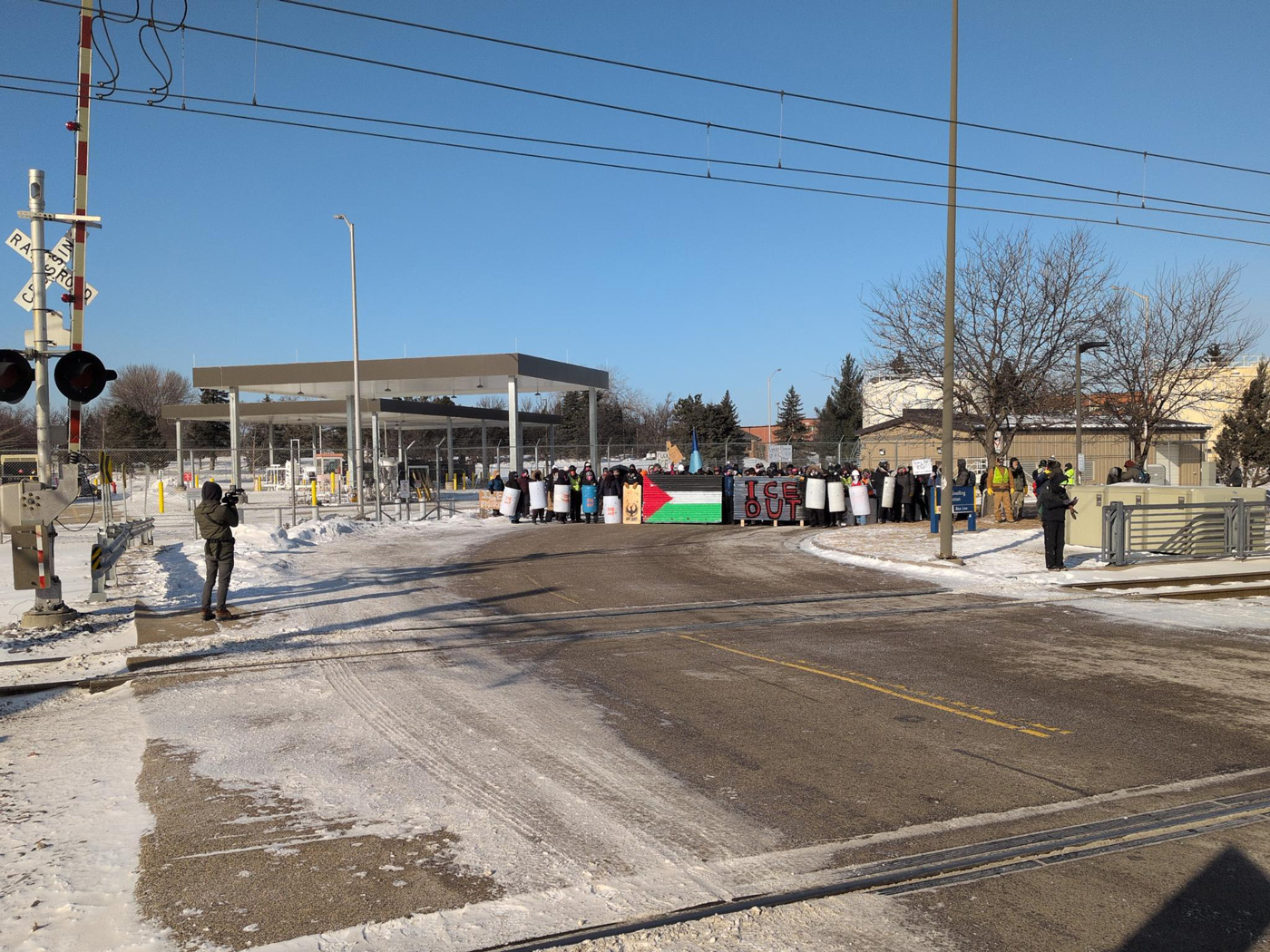
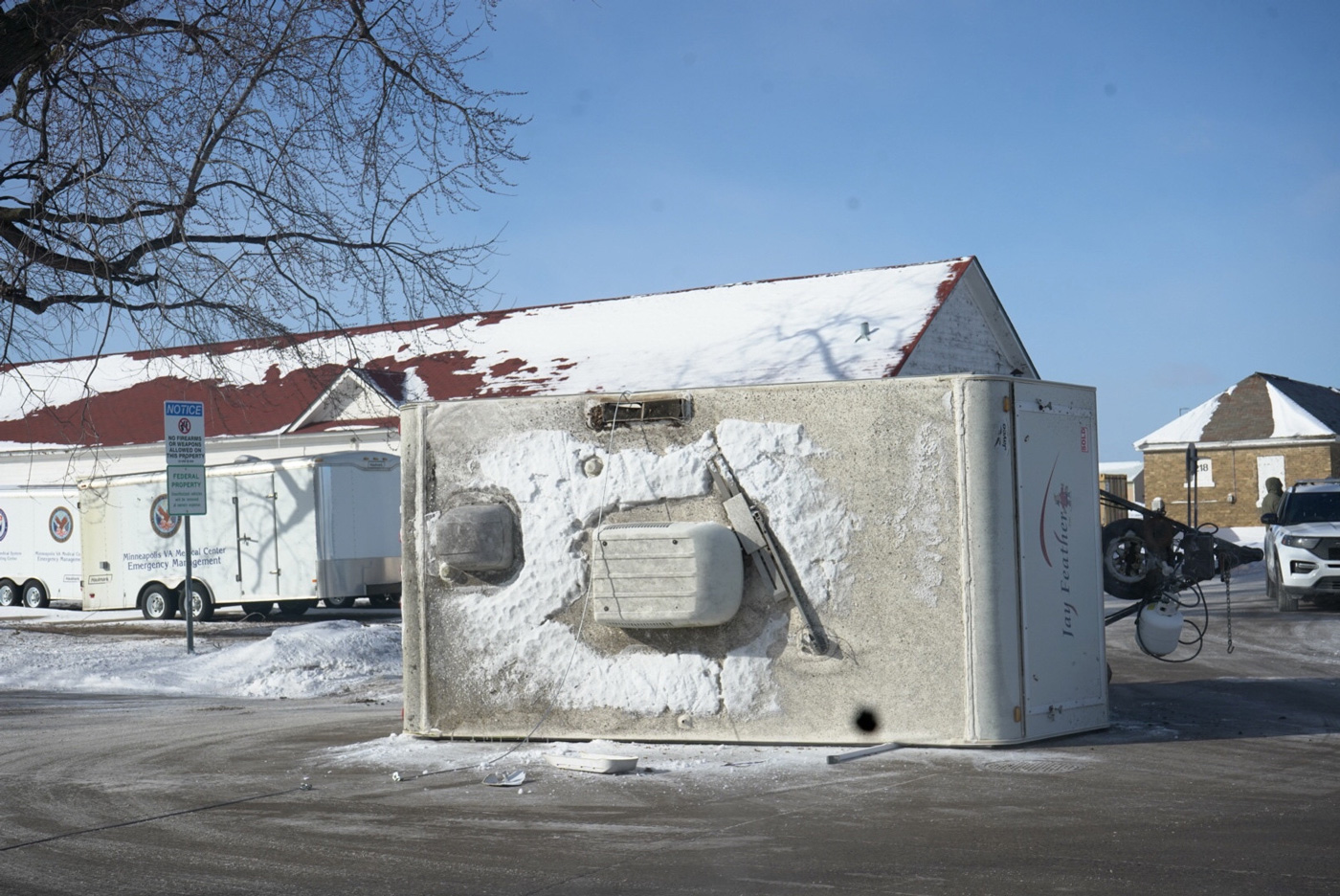
Early on the morning of January 23, in sub-zero conditions, roughly 75 demonstrators with shields and reinforced banners blocked the intersection of Minnehaha and Federal Drive, immediately adjacent to the Bishop Henry Whipple building, which ICE has been using as their base of operations in the Twin Cities. At the same time, someone left an RV trailer blocking Airport Service Road near the north end of Federal Drive (see map). This completely blocked two of the three means of ingress and egress to and from the Whipple building. Presumably, the blockade was intended to box ICE in at the north end of Federal Drive, blocking off every point of egress, but as it played out, they still had access to one exit.

The RV trailer blocking Airport Service Road remained in place for about half an hour. The demonstrators blocked the intersection of Minnehaha and Federal Drive for two and a half hours.

There was no sign of ICE or BorTac (the Border Patrol Tactical Unit, members of which have beaten and tear gassed protesters at prior actions by the Whipple building) during the entire two and a half hours. The ICE motor pool appeared almost totally full during the action, suggesting that they weren’t staging from any secondary location. It is possible that this action effectively trapped a large number of ICE agents at their headquarters.

Eventually, after the trailer had been removed, Hennepin sheriffs threatened to attack the demonstrators with chemical weapons. The participants in the blockade dispersed five minutes later, before chemical weapons were deployed. Two arrests were reported in the area, apparently not in connection with the blockade at the intersection of Minnehaha and Federal Drive.

The role of the sheriffs is noteworthy. From Chicago to the Twin Cities, local and state police that supposedly answer to Democrat politicians have played a fundamental role in violently suppressing protests in order to enable ICE to continue kidnapping and brutalizing people. Any movement against ICE will have to contend with this bipartisanship.

Two weeks ago, on January 8, protesters blocked the gates of the Whipple building for one hour in response to the murder of Renee Nicole Good by federal agent Jonathan Ross. Today’s attempt raises the bar. It is inspiring that thousands of people participated in today’s general strike. The blockade at the Whipple building shows that some are prepared to go further, taking bold and creative action to directly impact what ICE can and cannot do.

In the following anonymously submitted account, participants describe what they witnessed during the blockade and offer some context for their experiences resisting the ICE occupation.

Location 1: demonstrators blocked the intersection of Minnehaha and Federal Drive. Location 2: an abandoned RV trailer blocked Airport Service Road.


Three Forms of Conflict

“It’s been the longest year of my life.” You can hear this refrain throughout the Twin Cities—and it’s only January. More than fifty days of occupation by federal forces has weighed upon the resolve and well-being of resisters and occupiers alike.

The federal site at Fort Snelling, where the Whipple Building is located, is known for having served as a concentration camp imprisoning the Dakota people in the 1860s. This legacy continues today with the use of the site as the home base for thousands of masked kidnappers. The 3000 federal agents involved in this operation outnumber the ten largest police forces in the Twin Cities combined.

The first abductions began as a trickle and built to a stream, then a flood like the mighty Mississippi. The most henious and evil acts are burned into our brains, reminiscent of the sort of attacks the Israeli army has carried out in the West Bank: ambushes on schools and hospitals, masked invaders using terrified children as hostages, shootings, even a public execution. The piercing tones of 3D-printed whistles are scorched onto our eardrums like tinnitus. Yet the violence of ICE has fueled a shared rage that many people never knew they were capable of. Many new resisters are waking up to this reality for the first time. Others have experienced wave after wave of struggle in the Twin Cities, which have prepared many of us for this moment.

Fascism is not on the way. It is here.

In response, people prepared to go on the offensive on the day of the general strike. This offensive involved three different struggles, none any less important than the others.


Confronting the Self

Like many on the global stage, we find ourselves in unfamiliar waters. The old rules have been thrown out the window. In the streets, ICE acts more like Nazis than like cops. This is especially apparent to those of us with experience in anti-fascist organizing. Their terroristic tactics combine a mixture of brutality and cowardice; their unpredictable nature has strained even seasoned veterans.

This is the first form of conflict we must deal with: struggle against self.

Uncertainty breeds fear. We have use threat modeling to identify what the risks are and which ones we are prepared to run. Movement tactics like positioning sharpshooters on roofs, using security checkpoints, and sending security teams to escort people through dangerous areas have become common once again, as they were in the height of the 2020 uprisings. This is the case even for large meetings now. We study and practice these skills over and over, doing our best to address our fears while seeking to assuage anguish over those who have already been disappeared.

Care must be taken when deliberating too, as frustration can easily flare up over minor or inconsequential issues. Recognizing and regulating our own emotional states is key to avoiding the tendency to act on fear. Group visualization techniques present an opportunity to imagine possible outcomes and prepare our responses in advance.

The crime against humanity that we call genocide doesn’t just affect those who are abducted or killed. Those who remain must carry its weight. In the week leading up to the general strike, we wrestled with all of these things. Nonetheless, we pressed on.

Demonstrators with shields and reinforced banners blocking the intersection of Minnehaha and Federal Drive.


Confronting the Natural World

There is a difference between ordinary cold and bitter cold. It’s difficult to describe if you haven’t experienced it. In the bitter cold, there is almost a serene stillness to the air, a seeming tranquility daring you to underestimate its lethality. Literal arctic chills can spread through our state. A week ahead of the general strike, it became clear that it was going to be a very cold day.

This second form of conflict is just as dangerous as any human violence: struggle against nature.

I’ve seen one exposure death before. The glassy black skin on their body isn’t a vision I will ever forget. ICE have recently been taking a page out of the Saskatoon Police force’s “Starlight Tours” and dropping off arrestees in the middle of the night in remote areas, intentionally using weather exposure as a weapon of torture. On the morning of the general strike, temperature adjusted for wind chill was about -30 degrees Fahrenheit (-35 Celsius). This can cause uncovered skin to develop frostbite within twenty minutes, a challenge that requires careful planning and specialized clothing to address.

In the modern surveillance state, one must also take care to avoid being identified by one’s specialized winter clothing. Despite organized warming stations, several volunteers from out of town underestimated the risks and were injured from exposure alone. There surely would have been two or three times as many participants in the blockade were it not so bitter outside.

As in the fight against the Dakota Access Pipeline, there were concerns that state or federal forces might use water as a weapon. At one point, a scout identifed and radioed out what appeared to be preparations to employ a water cannon. In this weather, with no nearby facilities to warm up in, such a weapon could inflict permanent harm. Similarly, water to flush chemical weapons can pose a risk in these temperatures.

Tensions were high, but with extra jackets and handwarmers, we were able to hold the line.

The RV trailor abandoned in the middle of Airport Service Road.


Confronting the Occupiers

Being across the highway from the rest of the city, the Whipple Building is difficult to reach on foot and well-protected from pedestrians. Two days before the action, our adversaries added additional layers of fencing to create chokepoints and opportunites to trap demonstrators. They put up jersey barriers and fences on either side of Federal Drive, all the way down, separating the street from the sidewalk, blocking off every driveway—creating a sort of tunnel. Understood solely as a defensive tactic, this made sense in a mindset obsessed with violence. Though it also made it easier to blockade the route, as their fortifications left them only three exit points.

Four different groups prepared to take action to blockade those points. This is the final form of conflict we must confront: struggle against the occupiers.

One group walked in from the city and train station, carrying shields, steel banners, and other items. Their goal was to block the primary access point, diverting traffic. Arriving early, I saw items being distributed as people huddled for warmth in the exposed parking lot. At first, the numbers looked concerningly small. The group pressed forward to the chokepoint, occupying the area before the tunnel. The demonstrators could not get in, but the mercenaries would not get out.

Perhaps the latter had not prepared for this mutual achievement of goals. In any case, the only forces that these demonstrators encountered were three squad cars from the Hennepin County Sheriff’s Department. This is unusual. We have not previously seen sheriffs at the Whipple building; typically, this unincorporated land has only been used by federal agents. The federal forces remained holed up in the building, afraid to step into the cold. The demonstrators chanted and taunted them to draw their ire; still, federal agents did not show themselves. They took no offensive action of any kind.

Perhaps the federal agents, too, are exhausted from their long campaign of contemptible violence. Perhaps they were stretched thin from preparing to deal with the general strike. Perhaps they were more afraid of nature than the demonstrators were. Or perhaps they were obeying strict orders from their commanding officers not to engage, for reasons we can only speculate about.

In any case, it was unusual that they did not attack the blockade. The participants successfully retained all the equipment and supplies they had brought out to the action, which is unusual for such confrontations.

While that group held the city entrance, other groups took coordinated action elsewhere. One group towed blockading material into the highway entrance. The first convoy in this group apparently deployed an RV trailer and exited the area. A second convoy in the group left the area without deploying any sort of barricade, as sheriffs swarmed the trailer at the last second. The single RV trailer that remained nonetheless obstructed egress for nearly half an hour.

Finally, two other groups provided support and a human blockade on a side road. Unfortunately, sheriffs carried out two arrests there during an agressive push towards the fortified “tunnel.” Reportedly, snowballs were thrown at federal vehicles, shattering one window. Ice versus ICE.

After tear gas was deployed, many of the people in this area began coming over to the primary blockade, reinforcing the numbers at the intersection of Minnehaha and Federal Drive.

As the hard barricades were cleared and others poured in, the demonstrators took a moment to consider the situation. They had already achieved their objectives for the day, coordinating between several groups and seizing the opportunity of the general strike as a whole to grind things to a halt at the Whipple building. Given the opportunity to leave without sustaining losses, they chose to take it, leaving before weapons were deployed. They marched back as a single unit in a tactical retreat, still protected by shields and steel banners, chanting “Minnesota’s got the ICE melt!”

For two and a half hours, demonstrators had blocked all but one of the routes in and out of the Whipple building.


Today’s action only strengthens our resolve. Now we have more experience coordinating with one another and more knowledge of the terrain. The fact that federal forces did not show themselves reinforces the notion that they are not prepared to defend themselves in large confrontations—or at least, that they consider it preferable to avoid doing so. Their continued reliance on state police and sheriffs poses complicated strategic questions for us, but it could also create complications for them in the future.

As local comrades recently stated in regards to Donald Trump’s threat to invoke the Insurrection Act:

“We must continue to organize communities, patrol our streets and build rapid response teams, push for workplace stoppages, and grind them down every step of the way. We must exact a price for every footprint they leave in our snow. When we have the opportunity, we will drive them from our streets and tear down their concentration camp. ICE will melt when the heat turns up.”

Forever yours in struggle.

Read the whole story
rocketo
1 day ago
reply
seattle, wa
Share this story
Delete

Gavin Newsom Has Nothing To Offer

1 Comment

In California, a proposed law drafted by organized labor would impose a one-time tax on all the state's billionaires, equal to some portion of their total worth. Those whose net worth exceeds $1.1 billion would pay around five percent; five percent of $1.1 billion is $55 million, which would leave those Californians with a mere $1.045 billion in personal net worth. Those whose net worths fall between $1 billion and $1.1 billion would pay a lesser percentage of their wealth.

The proposal is called the "2026 Billionaire Tax Act," and while it could potentially generate some gigantic sum of money for the state of California, anyone capable of some basic math, and of even vaguely conceiving of how much money a billion dollars is, can see that it would not meaningfully deplete even those paupers whose personal net worth sits at a mere $1 billion. Those affected by the tax would be able to spread their payment over five years, beginning in 2027, in case any of these individuals whose personal wealth exceeds that of some island nations find themselves illiquid at the moment.

Among the proposal's opponents—including, of course, many billionaires, who reportedly have already begun planning their exits from the state in anticipation of a tax that may very well never come to pass—is California governor Gavin Newsom, who has boasted of working against its passage behind the scenes, and has promised to defeat the initiative should it ever reach his desk, where he could bring its passage into law to an end simply by refusing to sign it. (He can be bypassed in theory by putting the proposal to voters as a direct ballot initiative.) The Democrat, widely understood to have his sights set on the party's 2028 presidential nomination, has fought off taxes on extreme wealth at least twice before in his term, despite their strong popularity among residents of the state.


Read the whole story
rocketo
2 days ago
reply
“Lacking any systemic critique of America's broken politics, unwilling or ideologically incapable of situating Trump within America's much larger problems of wealth concentration and institutional rot, he gives material protection to an unaccountable, malevolent class of hyper-rich parasites with one hand, and makes an empty, theatrical, cornily homophobic gesture at attacking those same predators with the other.”
seattle, wa
Share this story
Delete
Next Page of Stories